Summer scoop: I have an NSERC grant!
This January, I applied for a summer Undergraduate Student Research Award (USRA) from the Natural Sciences & Engineering Research Council (NSERC). Lakehead University has 20 such awards to give to applicants this year, and on Monday, I learned that I am the recipient of one!
I was (still am) a mixture of elation and trepidation. Part of me is still in a state of shock and can’t quite believe that this is real. I spend a good half hour after learning I got the grant just trying to calm down so I would not run up to everyone I encountered and yell, “I GOT A GRANT!” Another part of me is saying, “What do you think you‘re doing, Ben? You don’t even understand what it is you’re going to be researching!” As anyone who has ever looked at a higher math textbook knows, the language is just scary sometimes.
I applied for the NSERC grant for two reasons. Firstly, it’s a different summer employment opportunity than my default, which is the art gallery. Don’t get me wrong: I love working at the gallery. You can’t beat the hours, and I have an awesome boss—she took the news that I wouldn’t be working there over the summer much easier than I thought she would. Nevertheless, I’ve worked there for four consecutive summers. I‘m not averse to trying something new, particularly something related to my area of interest.
Secondly, since this is a research position, I’ll get a chance to experience exactly what “math research” is all about. Sometimes people will ask me why I’m becoming a high school teacher instead of going on to graduate school and becoming a professor; usually my answer is somewhere along the lines that I‘m not sure I’d like doing “math research” and writing “math papers.” I‘m more in it for the teaching. This grant is a perfect way to see if, in fact, I like or dislike doing research, without committing to something like graduate school first.
So I’m excited about this change, but also just a little bit anxious—it is a big change in how I’ll be spending my summer, and a different responsibility. After four years at the gallery, I’m so used to doing the same thing every summer that it’s hard imagining myself doing anything else.
The position itself is a full-time for 16 weeks. My area of interest in mathematics lies in commutative algebra, so Dr. Adam Van Tuyl has agreed to be my supervisor. He’s come up with a neat project for me, and I’ll try to explain some of it. I don’t fully understand what I’m doing yet myself; for the first few weeks I’ll need to review my ring theory from last year and then work to learn new concepts we didn’t even cover in that class.
Ultimately I’ll be continuing work that Dr. Van Tuyl did on computing spreading and covering numbers for monomial ideals. One of the issues he and his colleagues encountered when they first worked on this problem was a lack of computational power for calculating values for these numbers. Later in the project, I’m going to be writing my own algorithms for calculating these numbers, and I should be able to run them SHARCNET, a network of high performance computers maintained by several academic institutions in Ontario.
I plan to blog about the project as the summer goes on. I start working on May 10, so I probably won’t have much to say on the subject until then. For now I need to focus on finishing the school year!
Battle scars
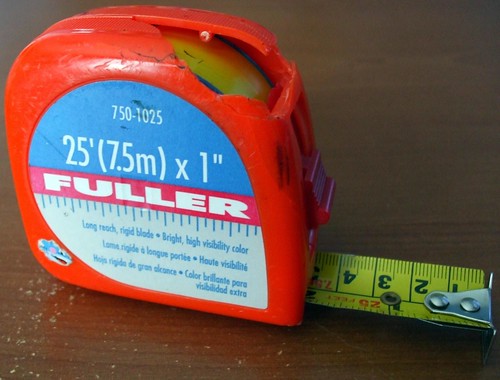
Some people I know lead off their blog posts with massive photos of the minute and the mundane, photos that set the mood for the entry that follows. So I‘m going to be a copycat and do the same. Muwahahaha.
There are some objects that, against all odds, manage to stay with us through childhood, adolescence, and into our adult years. These objects acquire and then store memories for us, exceeding their original purpose as they become receptacles for our past. And they acquire scars, reminding us that we can’t travel through life unscathed, but we can always somehow emerge OK. In a society renowned for its throwaway culture, these objects might be old, battered, and bruised, yet we keep them still. They have more than a material worth. At the same time, however, they might not have much sentimental value—that is, they haven’t survived all this time because we’re overtly fond of them. They’ve just stayed with us.
This tape measure is one such object—and a surprising one, at that, considering I‘m not especially handy nor prone to measuring things. All the marks on its body tell me a story about my past, and about who I was. I don’t remember who gave it to me or when, but I obviously put it to good—and not so good—uses. The missing pieces at the top are probably the result of one or many ill-fated drops; stress-testing just doesn’t account for the overzealous measuring abilities of a 12-year-old. The black splotches along the top and side appear to be paint. I don’t remember what I was painting, or indeed if I’m even the one who was using it at the time. This tape measure has made its rounds through my immediate family, so I can’t take responsibility for every little scrape and scar.
The shark sticker, though, is all me. I went through this phase where I obsessively decorated my possessions with stickers—I think, even then, I didn’t like acquiring stuff I wasn’t going to use, and I had all these stickers … and one thing led to another. Every so often I’ll come across an artifact of my stickering phase.
But most quixotic and endearing is the fact that this tape measure isn’t particularly valuable, isn’t precious or handmade. It was made in Taiwan, in fact, one of many tape measures identically mass produced. Handmade objects are exquisite, but if there’s anything mass production reminds us, it’s of how quickly two identical things diverge and become unalike. No doubt this tape measure’s extant brothers and sisters have acquired their own battle scars. I hope some of them still have owners who, like me, are grateful more for what they remember than what they measure.
Do you have an object that bears your battle scars?