Top 10 best and worst books I read in 2011
It’s that time of year again. Took me a little longer to do it, but I did it: I chose the 10 best and 10 worst books that I read last year. You can view their respective lists by following the links below:
Part of the reason for the delay was that I finally decided to bite the bullet and attempt to import all of my Goodreads reviews en masse. It actually worked out fairly well, so now constructing book lists is a less troublesome endeavour.
Book lists still don’t have a comment feature yet, so as always, I invite you to comment on my selections on this blog post—oh, and tell me what were some of the best and worst books you read in 2011.
OMG, one more Hugo post
Yesterday was the deadline for voting in the Hugo Awards. I submitted my final ballot on Friday. I managed to finish all of the Hugo-nominated works in the novel, novella, novelette, and short story categories. I also voted in the best related work and best dramatic presentation categories, and I voted for the John W. Campbell Award for Best New Writer. Here’s an overview of my picks for this year’s Hugos.
I wrote lengthy reviews on Goodreads for all of the novel nominees, so rather than a recap blog post that just links to those reviews, I will list them here. The ballot allows us to rank each nominee by preference, so that if our first choice doesn’t receive a majority of the votes, it gets stricken from the ballot and our second choice becomes the first, and so on. So I’ve listed the nominees in order of preference:
- The Dervish House, by Ian McDonald. This did not blow me away, yet it somehow stuck with me and persuaded me to give it five stars. I hope it wins.
- Cryoburn, by Lois McMaster Bujold. My first Vorkosigan novel, I enjoyed it but don’t really think it’s Hugo Award material. Still, it is the next best book on the ballot.
- Feed, by Mira Grant. As with Cryoburn, I can’t quite see this as a Hugo winner, but it’s still a good story.
- The Hundred Thousand Kingdom, by N.K. Jemisin.
- Blackout/All Clear, by Connie Willis.
And here are my choices for the other works:
- Best Novella
- Troika, by Alastair Reynolds
- Best Novelette
- “The Emperor of Mars”, by Allen M. Steele
- Best Short Story
- “For Want of a Nail”, by Mary Robinette Kowal
- Best Related Work
- Chicks Dig Time Lords, edited by Lynne M. Thomas and Tara O’Shea
- Best Dramatic Presentation, Long Form
- Scott Pilgrim vs. the World
- Best Dramatic Presentation, Short Form
- This was difficult, because three of the five nominees were Doctor Who episodes and all very deserving. On the other hand, “Fuck Me, Ray Bradbury” was also nominated, and it would be totally awesome to see a YouTube video win a Hugo Award. (And it is deserving of such an award too.) In the end, I voted for the Doctor Who episode “Vincent and the Doctor”, because its last ten minutes were perhaps the best part of that entire season of Doctor Who.
- Best Fan Artist
- How could I not vote for Randall Monroe?
- John W. Campbell Award for Best New Writer
- Saladin Ahmed
Reading the Hugo nominees meant I had no shortage of good reading material for July, even though it means I didn’t come close to meeting my goal of exhausting my to-read shelf by the end of the month! Also, this year I had a smartphone to use as an ereader, so I will soon post an evaluation of how it served me compared to print books and to reading ebooks on my computer.
Good books and a sleepy conscience
Sunday was mostly an odds-and-ends day. I cleaned my room, organized things, and finished some books. Although the threat of rain hovered constantly in the air, I even managed to do some reading outside. So I had a pretty good weekend.
I managed to finish both Persuasion and the Iliad. My to-read shelf was finally empty, which meant I could restock it with books from the rather oppressive overflow stack. I have forty more books on the shelf now, and the overflow now fits comfortably inside that blue milk crate! My goal is to empty the shelf again by the end of July—this is ambitious, I‘m aware, and made even more so by the fact that I also have to get through the Hugo Voters Packet by the end of July.
I’m voting in the Hugo Awards again this year. I first voted last year, when John Scalzi alerted his readers to the fact that the Worldcon organizers distribute a packet containing electronic copies of most of the nominated works. This year, the attending membership at Renovation is only $50. That is a small price to pay for access to all these wonderful works, not to mention the privilege of voting in the Hugos themselves. I’ll blog more about the awards once I have read more of the nominees.
My weekend was rather relaxing, and certainly not as active as my brother‘s. He spent almost the entire weekend outside in our driveway, doing body work on his truck. Brad’s dedication and work ethic never fail to amaze me. I’ll come home from my seven hours of math research, which includes high speed Internet and tea, collapse into a chair, and declare myself exhausted. Brad, on the other hand, leaves earlier than I do, comes home later from a physically-demanding job, and goes straight to work on his truck. He’s always working on his truck—and when he’s not, he’s helping his friends with their trucks, or going mudding. None of these activities particularly appeal to me, but I am glad I have someone around who knows how to fix my car when it breaks. Especially when he’s the one who broke it!
And now I’ll talk about my research for two paragraphs, which means some fairly intense math jargon. You have been warned!
This is the sixth week of my summer research. So far, it has been very similar to last year, which doesn’t surprise me. I have mostly been trying new approaches to computing the spreading number by looking at the symmetry of the graph. We can perform rotations and reflections on sets of vertices using the symmetric group, and Dr. Van Tuyl and I hoped this would lead to better algorithms for finding the spreading number (which, you may recall, is the cardinality of the maximum independent set on the graphs we are studying). Alas, although we have made many valiant attempts, a feasible solution remains beyond our grasp. We have several interesting algorithms I’ve been testing, but they either use too much memory or do not produce tight enough lower bounds.
This week I think I am going to finish up my look at the spreading number, regroup, and redirect my efforts. I will turn again to the covering number; last year I had a fair amount of success with a greedy algorithm to find an upper bound (specifically, a minimal clique covering). Despite our lack of success in computing new bounds for the spreading number, the time I’ve spent so far this summer has furnished me with some new tricks that I hope to put to good use in improving this upper bound algorithm. Also, I would really like to understand why the covering number in four variables corresponds to this integer sequence.
And so my summer continues: lots of reading, plenty of math. As we now ease into June and hopefully receive more sun, I want to get more writing and more programming (mostly for this site) done as well. I’ll try to keep the blog posts coming.
Top 10 best and worst books I read in 2010
For the third consecutive year I have prepared two top 10 lists of books. One has the best books I read last year, and the other has the worst books.
Recently I completed a new feature for my site, book lists. They do exactly what they sound like: lists of books I‘ve read, with reviews I’ve written on Goodreads. This is all part of a larger work-in-progress, which is a portal that offers an overview of my reading.
Rather than reproduce the list here as I have done in the past, I’ll just link to the two lists. Since book lists do not accept comments, however, please post your comments here!
And you may want to check out the lists from previous years.
I intend to analyze my reading statistics in detail like I did for 2009. Those should be available soon. For now, let me just say that I read 137 books in 2010—fewer than last year’s total, 156 books. My goal for 2011 is 166—I hope to regain my lost ground and better it by ten! Wish me luck.
Somehow I continue to acquire books
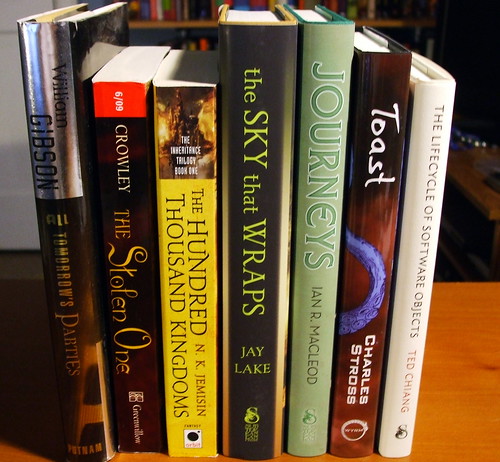
I’ve fallen in love with Subterranean Press, a specialty science fiction publisher. They release gorgeous limited editions of books by fantastic authors. Recently I bought an awesome special hardcover edition of Grave Peril, the fourth Dresden Files book. And a few weeks ago, I was weak-willed enough to spend money on four additional books from them!
Courtesy of BookMooch, All Tomorrow’s Parties, by William Gibson, and The Stolen One, by Suzanne Crowley, arrived in the mail last week. I am slowly collecting Gibson’s novels and hope to read them in some kind of order, so I probably won’t get around to All Tomorrow’s Parties any time soon. The Stolen One is Elizabethan-era fiction, marketed for young adults; I entered a giveaway for it on Goodreads and didn’t win, but it looked interesting enough to put on my BookMooch wishlist.
One of my discussion groups on Goodreads is reading N.K. Jemisin’s The Hundred Thousand Kingdoms this November. It looks like exactly the kind of fantasy I love, but I‘ve been trying to reduce the number of books I buy until I get through my backlog. (As this post indicates, I’m failing miserably at this!) But I had to go to Chapters last week to buy a birthday book for a friend, so I used that as an excuse to acquire this book—and only this book—for myself. As soon as I entered the store, I put my hands up to either side of my head like blinders and ran for the fantasy section.
So, what about these special books from Subterranean Press? Well, we’ve got:
- The Lifecycle of Software Objects, a novella by Ted Chiang. I read a review of this on io9. Since Subterranean Press books have a way of selling out quite quickly, I decided to snatch a copy while I was placing an order.
- The Sky that Wraps, an anthology by Jay Lake. Funny story: I actually haven’t read anything by Jay Lake, ever, yet I now own four of his books—this one, and his Clockwork Earth trilogy. He first caught my eye when I saw the release announcement for Green, which I haven’t actually bought yet (and hopefully won’t until I read these four books).
- Journeys, an anthology by Ian R. MacLeod. Like Lake, I haven’t actually read anything by MacLeod. The book just looked so nice and tempting, and I’ve heard so many good things about him.
- Toast, an anthology by Charles Stross. I’ve had Stross on my radar for quite some time now, and I had the opportunity not just to read Singularity Sky but study it in an English class last year. Stross has some great insight into possible avenues of the development of artificial intelligence, and I’m eager to read more of his short stories.
On romance and genre in literary criticism
Hello, my name is Ben, and I am a genre snob. Or at least I was. I‘m trying to quit, but as fellow genre snobs can attest, it is not easy to surrender culturally-inculcated notions of genre and embrace a more nuanced approach. Still, I need to try. For the children!
This week I read Amanda Scott’s Tempted by a Warrior, which I won in a Goodreads giveaway. Had I paid more attention when entering the giveaway, I would have noticed that the book is historical romance, not merely historical fiction, and passed. I didn’t notice, however, and I won the book. As I prepared to write my review, I discussed the book with a friend—who, as it happens, reviews paranormal, romance, and even paranormal romance1 for one of those review sites to whom publishers send books with the eager trepidation marketing people perfect after too many years in college.
I opened the conversation by quoting one of the sex scenes in the book:
Me: There is a list of words that automatically ruin sex scenes for me, and “tempestuous” is one of them.
Her: I can’t imagine why.
Me: Aside from that, this book isn’t that bad.
Her: “Turgid” tops my version of that list.
Me: Yes. And “tumescent.” Lots of T words, eh? “Throbbing” and “pulsating” don’t help either. Sometimes I can tolerate “throbbing”, but if any part of your body is “pulsating,” you should seek medical attention.
To be fair, the sex scenes aren’t actually that bad. There’s two of them, and aside from triggering my list with “tempestuous,” they are tasteful.
Oh, and this was before my friend realized which book I was reading:
Her: Are you reading that romance?
Me: Yes… . I‘m trying to parse everything now and make sure my reactions aren’t biased by the fact that this is romance. The rational part of me knows that there is nothing wrong with “romance” in general, just as there is nothing wrong with “science fiction” in general … but the irrational part of me insists this is not the case.
Me: Maybe it’s just fluff fiction I dislike, regardless of genre.
Sadly, this is wishful thinking, and I know it. Romance is the genre, for me, that belies my claim to be genre-neutral. I am sensitive to genre snobbery, because as a lover of science fiction, I dislike it when anyone shuns science fiction based on a claim that it is not “real literature.” But the moment somebody pulls out a romance, I recoil, and my prejudice rears its ugly head. I‘m worse than a genre snob: I’m a genre bigot!
And then my friend blew the discussion wide open by dropping the elephant in the room:2
Her: Remember, you have to review it as a romance.
Boom, suddenly my mind bifurcates. One Ben (we’ll call him Genre Ben) agrees with this proposition. The other Ben (we’ll call him Agnostic Ben) rejects it. A single sentence summarizes my internal conflict over how I write reviews and how I perceive books in general. It doesn’t help that I read a book about art criticism last week, so the subject is fresh in my mind.
Looking through my reviews, Genre Ben has left his fingerprints everywhere. Of thrillers, Genre Ben writes, “I don’t pretend to hold thrillers to the same standards as great works of art” (from this review). Even worse, when reviewing another romance, Genre Ben comes right out and says, “It’s unfair for me to expect this book to rise above its genre.” Right there, an implication that romance is somehow inferior. Oh, I am ashamed of you, Genre Ben.
The problems with genre are myriad. How does one define a genre? Who decides which genre—or genres, since a book can be more than one—a book inhabits: the author, the publisher, bookstores, the reader? I agree that as a naive labelling tool, genre is useful. For the purposes of criticism, however, Genre Ben makes me uncomfortable.
Agnostic Ben snickers, feeling victory is close at hand. Not so, for he does not hold the high ground. I happen to agree with Ursula K. Le Guin, who laments that she cannot review The Year of the Flood as science fiction. Le Guin respects Margaret Atwood’s desire not to be
… relegated to a genre still shunned by hidebound readers, reviewers, and prize-awarders. She doesn’t want the literary bigots to shove her into the literary ghetto.
Who can blame her? I feel obliged to respect her wish, although it forces me, too, into a false position. I could talk about her new book more freely, more truly, if I could talk about it as what it is, using the lively vocabulary of modern science-fiction criticism, giving it the praise it deserves as a work of unusual cautionary imagination and satirical invention. As it is, I must restrict myself to the vocabulary and expectations suitable to a realistic novel, even if forced by those limitations into a less favourable stance.
Le Guin’s point resonates with me, with both Genre Ben and Agnostic Ben. After all, genre influences our expectations. As Genre Ben observes in that earlier romance review, we expect westerns to have horses, outlaws, and guns; we expect science fiction to be filled with difference, whether it’s spaceships or robots. If the author insists her novel is not science fiction, then fine: it’s not science fiction, so all of this unrealistic language must be interpreted without the benefit of the science-fictional lens.
So at this point in my conversation with my friend, Agnostic Ben decides to move the marker:
Me: I only disagree in part. I agree that our conception of genre influences how we perceive a book, and that in turn affects how we write a review. Where I disagree is the premise that genre somehow alters the merits a book must have in order to judge its quality.
In other words, Agnostic Ben’s platform is that we should not condemn a book because it claims membership in a particular genre. My friend had none of it, however:
Her: It’s our job as reviewers to appraise whether or not the book meets the expectations of the genre … and to have a firm enough grasp of the intricacies and indiosyncrasies of each genre and subgenre to judge them as such.
Well said! I did not have an adequate response for this, and so I unfairly segued into an epistemological attack on the concept of genre, and a confession of my own insecurities on this entire issue.
In particular, I examined the fact that books often belong to more than one genre: the book that started this whole debate, Tempted by a Warrior, is historical romance. But is it really two genres—historical fiction and romance? Or is historical romance a subgenre of romance, much as, say, cyberpunk is a subgenre of science fiction? Or maybe the book is romance, and its setting is historical.
Sometimes when the debate over what constitutes science fiction comes up, I opine that science fiction itself is merely a setting rather than a genre proper. It makes sense, after a fashion. There are many different types of science-fiction stories: action-adventure, comedy, tragedy, even romance—the good old, classic genres, right? Science-fiction books belong to many different genres, sharing only the backgroup of a science-fictional setting in common.
I‘m not entirely comfortable with this argument. It does not seem to address the fundamental point both Le Guin and my friend are trying to make, the role of genre in a reader’s (or reviewer‘s) expectations and criticism. All I’ve done is relabel “genre” to “setting.”
So perhaps we cannot entirely rid ourselves of genre—it is here to stay, in one form or another. Then the question of defining genres becomes paramount. From the beginning, I have to dismiss any notion that genres can be disjoint. As “historical romance” makes clear, a disjoint definition will require so many subgenres as to make one’s head spin. Let’s go easy on ourselves and allow genres to overlap.
I will not attempt a general algorithm for categorizing a story by genre. I am an amateur at this game, and no doubt more learned people than I have tried. However, let me explore what passes for romance these days, since it is the central genre under discussion here.
Romance as a genre has undergone drift over the centuries. The Wikipedia entry for Romance (genre) refers to the traditional definition of epic or heroic narratives, tales of dazzling deeds. In the 19th century, Wikipedia explains, “the connotations of ‘romance’ moved from the fantastic and eerie … to novels centred on the episodic development of a courtship that ends in marriage.” Thus is born the the romance novel, which places its “primary focus on the relationship and romantic love between two people, and must have an ‘emotionally satisfying and optimistic ending.’” Wikipedia also notes that “the genre has attracted significant derision, skepticism, and criticism.”3
That definition comes from the Romance Writers of America, incidentally. The second clause, regarding an optimistic ending, surprised me in its specificity. It makes sense, however, because this clause differentiates romance from every other genre. People fall in love all the time—it is practically a disease—and characters in novels are no exception. The element of romance occurs in almost every story; after all, love is one of the most powerful sources of conflict. Some of my favourite books are love stories, wrapped in hilarious British absurdity. So a book just about romantic love between two people, even one whose primary focus is love, may not be a romance. Unless it has a happy ending. (I am a sucker for tragic endings, so maybe this is why romance and I part ways.)
My goal in this little exploration, in case you were wondering, was to find out why romance is its own genre when love is universal. The requirement of a happy ending is a good reason, but I‘m not sure if it is strong enough to make romance a genre in its own right. Agnostic Ben is shaking his head as I write this, but I want to deny any agenda here. I’m just investigating my own tastes, trying to discover why I avoid romance and whether I can rationalize this prejudice or banish it.
Nevertheless, I didn’t avoid this romance, and I did eventually write a review. I was more critical than I thought I would be. And that garnered a comment:
Frankly, I think more men should write romance novel reviews! Because they tend to cut directly to the problems and not gloss over what works and what doesn’t work. Whereas when women (like me) write snarky reviews, other women (hard-core romance lovers) get all bent out of shape—for whatever reason—maybe because they don’t want their novels have any mirror on reality or to be feasible/workable in real life.
While I don’t want to digress into a gender stereotype discussion, the notion that some reviewers (regardless of gender) “cut directly to the problems” instead of giving romance a free pass is an intriguing one. Because I think that was the visceral reaction Agnostic Ben had when my friend told me I had to review Tempted by a Warrior “as a romance.” Although she did not mean it that way, my first instinct was to interpret this admonishment as an instruction to be more lenient because, as Genre Ben would phrase it, “the book is just romance.”
No book is just anything though. Genre Ben and my friend might be right in that we cannot completely decouple genre from criticism—nor would be desirable, I suppose. By the same token, not all criticism stems from genre, and Agnostic Ben wants to give precedence to these genre-independent perspectives when deciding a book’s merits. Alas, it falls to poor, ordinary Ben, a mere mortal, to reconcile these positions and synthesize appropriate reviews. In the past I have often succumbed to genre snobbery; doubtlessly I will do so again, despite my vigilance. Hopefully, however, I will often succeed in going beyond—but not excluding—genre in my criticism.
Thanks to my addictive use of Goodreads, I have written a review for every book I have read since August, 2008—about 300 reviews in total. Many of them suck—more from being rushed without revision—but there are a few gems of which I am ridiculously proud. I like to take my endeavour to review the books I read seriously, and that requires serious thoughts about how I write reviews.
But I don’t want to take it, or myself, too seriously. So here’s a lolcat.

Thanks to the Hugos, I have not totally abandoned democracy
Those of you who read science fiction and fantasy and spend a good deal of time online are probably aware that we’re in the middle of the 2010 Hugo Awards. You can see this year’s nominees here.
While I fall into both of the above categories, I only paid the Hugos passing notice. Certainly, if a book has won the Hugo Award, or even been nominated, then I might give it more consideration before I begin reading it. But not every winner is a winner, if you know what I mean.
This year’s different, though. This year, I’m going to pay more attention, because I’m voting in the Hugo Awards.
Earlier this week, John Scalzi posted on his blog about the 2010 Hugo Voters Packet being available. This is an electronic copy of many of the works nominated for Hugo awards, which is distributed to people who have registered for AussieCon4 (and are thus eligible to vote in the awards).
A full ticket to AussieCon4 is $310 Australian dollars—and I have no intention of attending a convention. But all you need for voting rights is a supporting membership, which is only $70 Australian. I didn’t even need to use my mathematically-inclined brain to figure this one out: for $70, I got DRM-free copies of Hugo-nominated works. This includes all of the nominations for Best Novel. Best Novella, Best Novelette, and Best Short Story. Hard copies of the novels alone would probably set me back more than that (although I already own three of them), and tracking down the short stories, if I were so inclined, would cost even more. Plus, I have a copy of Neil Gaiman’s Batman: Whatever Happened to the Caped Crusader?, which i probably wouldn’t otherwise have read.
Oh, and now I can vote in the Hugos themselves. Which is rather the whole point of this exercise, but I‘m still salivating over all of the new reading material I’ve acquired. My Calibre library has suddenly increased in size, as these works join some public domain books from Project Gutenberg and freebies from Suvudu.
When it comes to this year’s nominees for Best Novel, I’m ahead of the game. As I mentioned, I already own Boneshaker, The City & The City, and Julian Comstock in hard copy. Julian Comstock was one of my top ten books of 2009. I’ve also read and gushed about Wake, so that leaves only two more novels, both of which look superb. I‘m just as interested in seeing which book I choose to support as I am in seeing which one wins.
So anyway, if you want to vote in this year’s Hugo Awards (and nominate works for next year’s Awards) and have $70, head over to the Aussiecon4 website and register. Even if you don’t care to vote, I urge you to check out any of this year’s nominees.
Top 10 best and worst books I read in 2009
Another year is behind us, and the Internet is inundated with all sorts of “best of” and “worst of” lists, including Rex Sorgatz’s List of Lists. Last year, I posted my inaugural annual list of best and worst books I read. I enjoyed pontificating so much about my favourite (and least favourite) books of 2008 that I thought I’d do it all over again for 2009!
Before we begin, let me explain. I use a site called Goodreads to track what I read. I joined Goodreads last year in May 2008, so I only had seven months’ worth of books—64, to be exact. Choosing twenty books as the best and worst of the “year” amounted to thirty per cent of the “year’s” total.
This year it’s different. I read 156 books, which gives me a wider selection and means I have to be a little more discriminating in choosing my top 10. In fact, winnowing the choice down to ten took more work than I thought it would. Sure, I could create a “top 11” or “top 12” list—why enslave myself to society’s arbitrary fascination with the number 10? But that’s not the point. The point is to limit the number of books I can showcase so I have to stop and consider exactly which books I consider worthy of this honour (or dishonour).
Top 10 Best Books I Read in 2009
10. Lilith’s Brood, by Octavia E. Butler

I read this book for my speculative fiction course in the fall term. Full disclosure: this is actually an omnibus edition of Butler’s Xenogenesis series, consisting of Dawn, Imago, and Adulthood Rites. However, since it’s only printed as the omnibus these days, I feel it’s only right to include it as a single book. From my review:
This is one of the scariest books I have read in a long time. Good science fiction, good posthuman fiction, challenges the idea of what it means to be human. Octavia E. Butler goes beyond that, way beyond, challenging not just what human means but how open-minded I am to such challenges. This book blew my mind.
9. Robert Charles Wilson

This is the first book by Robert Charles Wilson that I have read. While Julian Comstock didn’t “blow me away” like some of the books on this year’s list, it’s a solid, thought-provoking story. From my review:
As a didactic work of fiction, however, Julian Comstock embodies the sublime. It neither preaches nor lectures. There are precious few speeches. Instead, Wilson shows us a possible future, and as the consequences of his what-if game unfold, we see his themes in both the dialogue and the action: it takes strength to stand up against injustice, especially when it’s inevitable that you won’t live to see your victory achieved; the only comfort is the knowledge that this too shall pass.
8. The Dispossessed: An Ambiguous Utopia, by Ursula K. LeGuin

Last year, I ranked Le Guin’s Lavinia as my tenth-worst book of 2008, and I felt really bad. Le Guin’s a wonderful writer, and The Dispossessed reaffirmed that opinion. This was a latecomer to the race, as I read it only a few days before Christmas, but as my review demonstrates, it definitely deserves a place on this list.
Le Guin manages to make both nations seem viable, but it’s clear that neither are ideal places to live. There is no utopia, Le Guin proclaims. This is the common theme of utopian literature, of course, but The Dispossessed stands out because it’s discrediting two visions of utopia. And each has different flaws, different vulnerabilities. On Anarres, society the pressure on the individual to conform with social norms replaces laws. The danger of this, however, is that it stifles the very foundation of Anarresti society: “we didn’t come to Anarres for safety, but for freedom. If we must all agree, all work together, we’re no better than a machine.” On Urras, we see classical forms of government with classical flaws: the individual becomes subordinate to the State and the Economy, slave to the twin whips of Authority and Profit. Despite these obvious flaws, however, it’s clear that these are visions of utopia. And that’s where it really gets interesting.
7. Remix: Making Art and Commerce Thrive in the Hybrid Economy, by Lawrence Lessig

The copyright wars are raging all around us. Corporations face off against teenagers. Words like “pirates” and “criminals” abound, whether or not such labels are deserved. Lessig’s book is a well-reasoned look at the current state of copyright and what we can do to put copyright back on track. From my review:
Lessig’s stance reassures me that there is nothing wrong with the concept of copyright itself—indeed, so-called “free” licenses, like Creative Commons and “copyleft” are also copyright, just of a different breed—the core dilemma we face is that copyright has become distorted during the twentieth century by increasingly restrictive regulation. Lessig argues that we need new legislation to remove our copyright quagmire and update our laws to reflect current cultural values
6. Little Brother, by Cory Doctorow

Doctorow is one of those chimeras who manages to sound like he’s writing popular fiction (perhaps even “young adult” fiction, although I’m hesitant to label Little Brother in such a restrictive way) even though his book is clearly polemical. By no means a perfect book, Little Brother managed to make me passionate enough that my review turned into a polemic as well!
This isn’t Luddite fear-mongering either; Doctorow’s addressing real concerns about the intrusive nature of new-old technologies like RFID. These aren’t issues that affect only the military or upper class white-collar workers or secret agents; these issues affect everyone, rich or poor, desk or factory, government or private sector. And they affect us here, now, today—not tomorrow. Doctorow is clearly on one side of this issue, but even if you eventual come to stand on the opposite side, at least you’ll be choosing a side. If you remain apathetic, then you will have no voice in this silent revolution. And if you have no voice, how can you really call yourself free?
Also, you can download Little Brother for free in a variety of formats, no DRM at all, courtesy of a Creative Commons Attribution-Noncommercial-ShareAlike license.
5. Fool, by Christopher Moore

I have many friends who swear by Christopher Moore, so this year I gave him a try, starting with Fool. Anyone who likes irreverent Shakesperean comedy will love this. From my review:
Take Fool with a grain of salt and suspend your disbelief and you’ll be rewarded with a funny and entertaining story. I laughed out loud at several parts of the book, something I very rarely do, and was ready to grant the book five stars when I was less than halfway through (contingent on the book remaining awesome, which it did). Not only is Fool fun and easy to read, but it makes Shakespeare accessible to people who might otherwise never find time for the Bard—I‘m looking at you, vapid Twilight-enslaved teenage populace. Fool isn’t a replacement for King Lear, and maybe I‘m just being too idealistic here, but I hope it’ll stir up more interest in Shakespeare, who could be every bit as bawdy as Christopher Moore.
4. Foucault’s Pendulum, by Umberto Eco

Eco is the only author to make the top 10 list two years running now. While I found The Name of the Rose interesting and profound, Foucault’s Pendulum was a sublime work of literature. From my review:
At its core, Foucault’s Pendulum is a fable about conspiracies. It is a cautionary tale that demonstrates what happens when people begin to believe in conspiracy theories; lending credence lends life, which can have unfortunate consequences for everyone involved. The main characters begin as sceptics, working for a publishing house that’s allied with a vanity press, who begin constructing a fictitious Plan by connecting seemingly-disparate historical facts. When organizations and individuals begin showing up seeming to be acting in accordance with this Plan, however, our protagonists realize that if you make up a Plan, even a false one, someone might try to execute it.
3. Middlemarch, by George Eliot

I don’t care what you think about Victorian novelists or how much you love or hate Jane Austen, the Brontë sisters. I don’t care if you named your kid after Charles Dickens or personally made a pilgrimage to see the heart of Thomas Hardy. Forget everything you know about rural Victorian England. Middlemarch is, hands down, the best Victorian novel ever.
As I put it:
Eliot masterfully balances several related but distinct plots that take place in the fictitious town of Middlemarch. Although the story takes place during the Great Reform Bill of 1832, politics plays a secondary role. The story is largely character-driven and focuses on rural English life, which sounds boring until you realize that it’s utterly fascinating. It’s like the Victorian version of reality television.
Or as Siobhan Adcock puts it:
Best. Goddamned. Book. Ever.
Seriously, this shit’s bananas. B-A-N-A-N-A-S. 750 pages in, and you‘re still being surprised. It’s 800 pages long and EVERY SINGLE PAGE ADVANCES THE PLOT. You cannot believe it until you read it.
2. Midnight’s Children, by Salman Rushdie

This is only the second book I’ve read by Salman Rushdie, yet I feel so familiar with his work already. The brilliance of Midnight’s Children is so subtle at the beginning but quickly crescendoes. From my review:
In fact, the actual experience of reading Midnight’s Children reminded me why I love prose so much, why reading is eminently superior to other forms of entertainment (I’m looking at you, television!). In the hands of an author like Salman Rushdie, words can transcend language, and prose becomes beautiful. While other authors can describe a scene in such a way that I feel present, that I can smell the smells and feel the textures, Rushdie wields a different sort of literary magic: his words evoke emotions, their euphony resonating with the soul and reminding us of the beauty of life itself. I savoured the words of Midnight’s Children…
1. The Gone-Away World, by Nick Harkaway

Seldom do I so thoroughly enjoy a book as I did The Gone-Away World. It’s just fun. From my review:
The genius of The Gone-Away World sneaks up on you in a loud and bombastic way. Nick Harkaway’s writing reminds me two Douglases who are masters of the absurd and apocalyptic: Douglas Coupland and Douglas Adams. Sardonic and observant, Harkaway tosses off scene after scene of unrelenting zany fun. Yet when the smoke clears and the score is tallied, The Gone-Away World is ultimately, like JPod or The Hitchhiker’s Guide to the Galaxy, about what it means to be human.…
The book goes on to explore how some people use cognitive dissonance to keep their humanity intact in dehumanizing lines of work, whether they are appallingly destructive or just mindlessly tedious. The Gone-Away World isn’t merely about retaining one’s humanity in the face of external threats like Stuff; it’s a cautionary tale about unintentionally sacrificing one’s humanity in the name of doing good.
Shortlist for the Best
Some books that made the shortlist, in alphabetical order by author:
- Jane Eyre, by Charlotte Brontë
- Wuthering Heights, by Emily Brontë
- Never Let Me Go, by Kazuo Ishiguro
- The Left Hand of Darkness, by Ursula K. Le Guin
- Wake, by Robert J. Sawyer
Top 10 Worst Books I Read in 2009
10. The King’s Grace, by Anne Easter Smith

To be fair, this book isn’t bad so much as incredibly bland, which is why it’s all the way up at number 10 on the list. From my review:
Wrestling with my mixed feeling toward this book, I‘ve ultimately decided that the problem is the writing more than the story itself. The story should be interesting: rather than the battles and machinations per se of final chapter to the Wars of the Roses, we get to see the relationships among the sisters of York as Tudor secures a definitive Lancastrian victory, only to have to put down an upstart impostor to the Yorkish crown. Every so often I’d see a glimpse of depth and drama—such as Grace’s observations about Elizabeth Woodville’s treatment of her daughters vis-à-vis Woodville’s treatment of Grace. Then the book would shy away and sink back into turgid mediocrity.
9. Drood, by Dan Simmons

This is a controversial pick, since I know that Dan Simmons has a large fanbase that will no doubt give Drood much acclaim. As much as I enjoyed Hyperion, Drood did less than nothing for me:
… I shouldn’t be upset about supernatural elements in a book that is supposed to be supernatural, right? Except that the entire “Drood” mystery is conflated by the prospect of it all being an opium- or mesmerism-induced fantasy. Perhaps I just dislike it when the supernatural elements aren’t blatantly real but merely just suggested.
8. The Ex-Mrs. Hedgefund, by Jill Kargman

I admit I knew I wouldn’t like this book prior to reading it, and some may think that including it on this list is unfair as a result.1 From my review:
By refusing to choose between a serious satire of hedge-fund-wife society and a silly romantic summer read, Kargman undermines her own story, transforming it from something with great potential into just another mediocre romantic comedy. Pandering to everyone just won’t work. Good literature has to take risks, even if they don’t pay off, and even if they alienate one audience in favour of another. The Ex-Mrs. Hedgefund has a couple of moments of shining glory tarnished by the absence of any element of risk.
7. The Forgery of Venus, by Michael Gruber

From my review:
I eked very little enjoyment from The Forgery of Venus. As romantic and attractive as the art forgery scene may seem, Gruber manages to quash that feeling in his drug-induced insanity plot. Had I any sympathy for the protagonist after the first few chapters (which I didn’t), in which he whines about how unfortunate his life has been, it would have slowly bled out of me while I watched Chaz firmly refuse to take any responsibility for his own life.
6. Elsewhere, by Gabrielle Zevin

Imagine a book that tells you about what happens in the afterlife. Now imagine that book, only with flat characters and an afterlife in which nothing happens and there’s no such thing as religious resolution. Then you have the unsatisfying atmosphere that is Elsewhere:
Elsewhere ducks the question of souls and religion in general, giving us a throwaway line that “God’s there in the same way He, She, or It was before to you. Nothing has changed.”…
Everyone lives in a nice house, has a nice job, and is nice to people. Yet if Elsewhere itself is an allegory for growing up and leaving behind adolescence, what does that say about life in general? This is jarringly inconsistent with adolescence, adulthood, or any other period of life. The moral of Elsewhere seems to be that a life without conflict can be rewarding, and I don’t see how that can be the case.
5. Memoirs of a Teenage Amnesiac, by Gabrielle Zevin

No, that isn’t a typo. Gabrielle Zevin receives the dubious distinction of making my list of top 10 worst books of 2009 twice.2 And it wasn’t a contest deciding which one was worse: Elsewhere is unfulfilling, but the themes of Memoirs of a Teenage Amnesiac are downright disturbingly stereotypical. From my review:
If anything, Memoirs of a Teenage Amnesiac reminds me of why I‘m glad my years as a teenager are coming to an end: way too much drama. And not the funny-yet-vicious sort of drama I enjoyed watching in Tina Fey’s Mean Girls; no, this is the pointless-yet-ubiquitous drama created as a byproduct of our own struggle to discover who we are. Unfortunately, Zevin seems to focus on this byproduct while ignoring the end goal—the whole self-discovery thing.…
It’s a zero-sum book, because its main character never really changes.
4. Sex and the High Command, by John Boyd

Much like The Ex-Mrs. Hedgefund, this is a book I knew would be bad beforehand. I read it precisely because I wanted to write a snarky review. So while its appearance on this list may be slightly unfair, its ranking must ultimately reflect how bad it is—and as much as I disliked some of the books on this list, few of them are worse than Sex and the High Command. From my review:
As a story, however, Sex and the High Command severely lacks anything resembling a sensible plot or realistic character development. Again, my context is a little vague here. What resources I could turn up seem to indicate that this isn’t satire, but it belongs to a school of sci-fi that’s tongue-in-cheek in its approach, bordering on absurdism but not quite philosophically adept enough to earn that label. It reads like a Saturday Night Live sketch that’s 212 pages long and has also ingested steroids.
3. The Algebraist, by Iain M. Banks

I‘ve heard positive things about Banks, but so far I’m underwhelmed. While I somewhat enjoyed Consider Phlebas, The Algebraist was a big disappointment:
The signal-to-noise ratio of The Algebraist is terribly low. There are so many names, species, and places irrelevant to the plot that I had trouble following the plot (although maybe this wasn’t a bad thing).…
It’s as if The Algebraist is a simmering pot of water that, about 100 pages in, comes to a boil, and then all of the water boils away. The threat just evaporates by the end of the book. Long before that happens, however, my patient evaporated.
2. History Play: The Lives and Afterlife of Christopher Marlowe, by Rodney Bolt

From my review:
I have to admit I was skimming by the time I reached the halfway point of History Play. Its stultifying writing made me want to put it down, but the rational part of me wanted to see how it ended. It probably wasn’t worth it, in retrospect … as it is History Play is lifeless, limp prose.
1. The Expected One, by Kathleen McGowan

Let’s put it this way. While reading through my reviews to decide which book would earn the title of “worst read in 2009,” The Expected One clinched it when, in the first paragraph, I compare it to last year’s worst book, The Art Thief. As with last year’s title holder, the worst book I read this year is one to avoid at all costs:
What begins as innocuous conspiracy-orientated historical fiction ends up becoming a delusional and boring dissertation on the “truth” behind Mary Magdalene … this novel is semi-autobiographical…. It gets worse.…
The Expected One is empty; the story, its inspiration aside, is poorly written. A good book should appeal to the reader even if he or she disagrees with its themes. The reader should be entertained by the quality of its writing and its story. When a book becomes limited to an audience of approval, there’s something wrong.
Shortlist for the Worst
Some books that made the shortlist, in alphabetical order by author:
- Watermind, by M.M. Buckner
- Counter-Clock World, by Philip K. Dick
- Haze, by L.E. Modesitt, Jr.
- The Lost Diaries of Adrian Mole, by Sue Townsend
- Beyond the Gap, by Harry Turtledove
Want to Learn More?
But wait, that’s not all. I’ve also done a statistical analysis of my reading in 2009 using OpenOffice.org Calc and data gleaned from Goodreads. It’s amazing what consistent tracking of my reading habits and a couple of hours playing around with a spreadsheet reveals about what I read and how I write my reviews.
My doomed love affair with the Kindle
Some big news in the Canadian tech industry this week was the advent of the Amazon Kindle in Canada. I’ve mentioned my mad love for the Kindle previously as well as my discomfort with Amazon’s approach to tethered appliances. So, now that the Kindle is finally available here, will I be getting one?
The short answer is no, not right now. Technologically, I think the Kindle is an amazing device that uses some pretty interesting physics to make reading easy and comfortable. It boggles my mind that we have the ability to store so many books in such a small, slim shell and take it anywhere with us! However, I still have reservations about whether an e-reader is necessary, and I’m still set against tethered appliances. So here’s the long answer.
One More Piece of Luggage
When you leave the house, what do you check to make sure you’ve got with you? Keys, mobile phone, ID, maybe money? What about your Kindle?
I’ve got this bizarre notion that, if I one day get a smartphone, I could use that device as my e-reader as well. It makes sense to combine them; we‘ve already rolled music players and cameras into our phones. It’s one less device to worry about forgetting at home—or worse, elsewhere.
Of course, the Kindle (and other e-readers) are superior technologically for reading books. Their screens are designed to make it easier to read, and their battery life will probably last longer if you‘re just flipping pages. I can see how an e-reader would be a sensible investment for someone who doesn’t want or have a smartphone. And I don’t deny that some part of me wants an Amazon Kindle.1 I‘m just not convinced that it makes the most sense.
The Ol’ Ball and Chain
No matter how attractive or sensible the Kindle may be, it’s still tethered to the home office. Like the sleek and shiny iPhone, the Kindle is loyal to its manufacturer, not to you, the consumer. When you buy the Kindle, you’re just buying a device that’s a gateway to all the other content Amazon wants you to view but not own. The Kindle is a gateway drug.
Amazon demonstrated the draconian way it can manage Kindle content in July, when it deleted illegal copies of 1984 from people’s Kindles. To Amazon’s credit, apologies were made, and an Amazon spokesman assured us that it would never happen again—that, in fact, changes would be made so Amazon could no longer delete books remotely. It’s still a sobering reminder that, despite your physical possession of the Kindle, it isn’t really yours.
I‘m aware that the Kindle can read multiple formats, including yummy plain text files from Project Gutenberg. Yet the Kindle’s main goal is to persuade you to buy “Kindle editions” of books you want to read. These are proprietary files that only authorized devices can read, whereas a plain text file is readable by any number of devices. There are two problems with this. Firstly, it allows Amazon to control when and where you have access to the book you purchased. Secondly, it raises the spectre of data loss—since only Amazon-authorized devices can read the Kindle format, what happens if Amazon disappears? Unlikely, but still possible. Realistically, there are ways to cirumvent the DRM protection on the Kindle format and retrieve one’s data, but they aren’t legal, which leaves you in the interesting position of having to break the law to get at content you bought. An open format is safer when it comes to preserving and backing up.
I‘m using the Kindle as an example because of its release in Canada, but Amazon is not the only company doing this to its e-readers. Sony, whose Reader line has long been available in Canada, also has a DRM format. And when Barnes and Noble’s e-reader comes out, I‘m sure they’ll have a proprietary format as well. This isn’t the exception but the rule. And it’s up to us to change that.
Why? Well, Amazon, Sony, and B&N are doing what they think is best for their bottom line. They don’t want freely available, easily re-distributable books that will cut into the profit margins for themselves, for their publishers, and for their authors. I understand the desire to cut down on privacy, but we’ve been down this road before. There’s a reason that recording labels have finally agreed to drop DRM from iTunes. These bookstores, like the recording industry and the newspaper industry, are clinging to an outmoded idea of copyright and redistribution. Amazon, as a solely online venture, should know better. Clearly it doesn’t.
In Which I Return the Soapbox to Its Rightful Owners
So that’s why we, the consumers, need to show that this isn’t the model we want.2 Or at least, that’s what I think. I don’t know. Sometimes I feel old and codgery. I‘m a technophile who refuses to get a smartphone because I’m holding out for something that runs Google Android, and I refuse to change to a carrier that does offer an Android device because the competing carriers in Thunder Bay have ludicrous service and pricing compared to TBayTel.
Maybe I should just get off my high horse and admit that yeah, the Kindle is pretty darn awesome and I‘d love to have one. But I can’t do it. I just can’t. I could probably surrender on the smartphone front, one day, if I so desired. This is different.
This is about knowledge. Books are one of the most precious resources of knowledge we have, and I will not be party to locking them away under the guise of “copyright protection” and “digital rights management.” I will not be complicit in the gradual erosion of the public domain, nor in the partitioning of content by format and fiat.3
If you‘re new to this debate and want to learn more, I’ll point you to the (somewhat biased) work of Cory Doctorow, Michael Geist, Lawrence Lessig, and Jonathan Zittrain, great advocates for a more open Internet.
I’m going to go read a non-DRMed book.
- [ 1 ] The three-year-old, “I want it! I want it! I want it!” part.
- [ 2 ] Yes, I‘m advocating that we let the free market decide. I’m not totally socialist!
- [ 3 ] Twenty years from now, assuming this blog hasn’t been locked away behind some proprietary wall, the cynical Future Ben will look back at Present-Day Ben and shake his head at Present-Day Ben’s naive idealism. But until that day comes, I’m allowed to be as naive and idealistic as I like!
Last updated Thursday, October 14, 2010 at 11:22 PM
Welcome to the Walled Web 2.0
As much as I am in love with the technological achievement that is the Amazon Kindle, I have to chastise Amazon and the producers of other eBook readers for what I see as a step backward.
You may have heard last week about Amazon deleting books off Kindles. This is worrisome because—as Jonathan Zittrain explains—it emphasizes how much you don’t own what you “buy” from Amazon or any other company that digs its claws into you by selling you tethered goods. We sacrifice our freedom to keep what we purchase in return for a little convenience in the purchasing.
That’s not all though. Barnes and Noble, bookstore rival to Amazon, plans on launching its own eReader from Plastic Logic. Now, I’m all for competing eReader devices and competing eBook stores. Competition breeds innovation. But what I don’t like is this:
At this point, B&N’s plan becomes clear—the books will be tied to the B&N e-reader, and not downloadable by Kindle or Sony Reader owners. Essentially B&N is trying to set up a closed ecosystem that’s a direct rival to Amazon’s, and that’s based from its bricks and mortar stores and a website, versus Amazon’s 100% cloud-based solution.
A synonym for “closed ecosystem” would be “proprietary network.” This harkens back to the early days of the World Wide Web, when the Web consisted of disparate service providers like CompuServe and Prodigy. Rather than buying the eReader right for me and then buying books from various online sources, I’m going to be locked into a single provider for my content—and apparently they have the right to veto my access to that content, even if I‘ve paid for it.
(To the credit of Barnes and Noble, their eBooks will not be restricted just to their Plastic Logic eReader. According to the Fast Company article to which I linked above, they will also have software available for the BlackBerry, PC, and of course, the notoriously proprietary iPhone. This is one step up from Amazon’s strategy with Kindle eBooks, I suppose.)
I understand why stores like Amazon and Barnes & Noble are doing this. They’re just trying to make a profit. And part of me wants to say, “OK, try it your way, and see if this works.” Yet I worry that such an attitude will do more harm than good, especially for authors and publishers. I sincerely doubt publishers will ever make much money on eBooks. The role of eBooks is in publicity, in attracting new fans and moving physical versions of the book—because rest assured, physical books aren’t going to disappear as eBooks gain popularity. Give the digital copy away for free, then charge for the hard copy.
Critics contend that this model is unrealistic: after all, then everyone with an Internet connection will just download the free copy and the publishers and authors would lose money! I somehow doubt that. Firstly, I much prefer reading books in hard copy, and most readers share this sentiment. Even improvements to eReaders to make reading more comfortable (such as the e-ink screen on this generation of eReaders) will never equal the feel of a bound paper volume in my hands. Secondly—and I‘m sure you’ve noticed this yourself—having easy access doesn’t automatically mean I’ll take advantage of it. I currently have easy access to 30,000 free books from Project Gutenberg. Guess what I‘m doing right now? That’s right, I‘m not reading a single one. Because I’m lazy. On the other hand, if I‘ve got a physical copy of a book on my shelf, I have an impetus to read it.
But hey, maybe I’m just a dreamer. It’s not my job to come up with new revenue models, just to shoot down existing ones!
Incidentally, if you’re looking for more information on this subject, check out Jonathan Zittrain’s The Future of the Internet—And How to Stop It, available for free download under a Creative Commons license. And if you like the book, buy the hard copy version. 
Your rose-coloured glasses are on fire
Funny story. Last night I got an email from my friend Maria, who recommended to me her friend’s LibriVox audio recordings for my summer audiobook odyssey. Since it’s as good a place as any, I decided to begin with John Milton’s Areopagitica.
For those of you unfamiliar with Areopagitica,1 Milton wrote it back in 1644. In many ways, the world was different back in 1644: global warming wasn’t as much of an issue back then, the roads were slightly better, and Clint Eastwood had just starred in his first movie. Yet in many ways, the world was very much the same: young kids listened to pop music that drove their parents crazy, celebrities got into tabloid scandals, and short-sighted people wanted to censor books.
Areopagitica is a polemic against the Licensing Order of 1643, which would essentially establish government censorship over all published works. Milton argues passionately and eloquently that such an order is foolish, that censorship is ineffectual and indeed harmful to a free society. He cites the examples of the Greek and Roman societies2 and goes on to extol reading and learning in general.
Now, Milton’s idea of “freedom of speech” was slightly different from what we interpret it to mean today. To Milton, freedom of speech means the freedom to pursue the study of knowledge of the sake of worshipping God. And he wasn’t against burning books after they were decided to be harmful; he just didn’t want books to be censored before being published and judged by a wide audience. Most of Milton’s argument, however, remains valid today: censorship is a bad idea. Books are good.
So why do some people insist on ruining the fun for the rest of us?
See, today I learned that yet another group of people want to burn books. So it’s serendipitous that I’m listening to what we might call an ur-tract—in the English language, at least—against censorship. Milton’s arguments remind me, a bibliophile and staunch opponent of censorship, why we shouldn’t burn our books.
To clarify, if you haven’t read the article, this Christian group wants the right to burn library books. I don’t care if people burn books they‘ve purchased or published themselves. It’s their property, and they have a right to do with it as they please. However, burning library books would be, in my perfect world, a capital crime. Burning a book is a terrible thing:
For books are not absolutely dead things, but do contain a potency of life in them to be as active as that soul was whose progeny they are; nay, they do preserve as in a vial the purest efficacy and extraction of that living intellect that bred them. I know they are as lively, and as vigorously productive, as those fabulous dragon’s teeth; and being sown up and down, may chance to spring up armed men. And yet, on the other hand, unless wariness be used, as good almost kill a man as kill a good book. Who kills a man kills a reasonable creature, God’s image; but he who destroys a good book, kills reason itself, kills the image of God, as it were in the eye.3
And see, Milton’s a Christian. He’s all about God in this matter. So when I say this is a “Christian group”, I mean it’s a group of people who say they’re Christian (according to the newspaper article anyway). They don’t seem to be acting in a very Christian matter. But whatever; it’s a free country, right?
Well, only as long as you don’t publish “explicit” books, apparently. This group wants to remove a book called Baby Be-Bop because it discusses homosexuality and has some fairly explicit content. I haven’t read the book, so I won’t judge.
The group argues it could be mentally and emotionally damaging to children. I’m not a parent, but maybe I will be one day. And it seems to me that if you consider your child too young to protect himself or herself from “dangerous” material, then you shouldn’t let your child wander around alone in a public space. It’s that simple. I’m not against parents deciding what their children read—I would hope that parents educate their children widely and openly, but ultimately it’s their business. There comes a time, however, when you have to let your child grow up.
For that reason, I find this quotation from the Guardian article particularly laughable and dangerous:
Their suit says that “the plaintiffs, all of whom are elderly, claim their mental and emotional well-being was damaged by this book at the library,” and that it contains derogatory language that could “put one’s life in possible jeopardy, adults and children alike.”
It’s one thing to argue that material could be harmful to children. I personally take such claims with scepticism, but I at least understand that they originate from a desire to keep children safe and healthy. All right. But now you want to censor books because they might harm adults? All my life, I grew up believing that to be an adult is to have the ability to do whatever one wants (within reason), including reading whatever I want. The idea that I need a moral “Big Brother” is … well, it’s offensive. It implies I’m not mentally fit to judge what may harm my emotional wellbeing. If that’s the sort of society we want, then it wouldn’t really be free, would it?
Interestingly enough, I came across another free-speech-related article in the book I’ve just finished, The Best American Nonrequired Reading 2007. This from Daniel Gilbert’s “dangerous idea” entitled “The Idea That Ideas Can Be Dangerous”:
We live in a world in which people are censured, demoted, imprisoned, beheaded, simply because they have opened their mouths, flapped their lips, and vibrated some air. Yes, those vibrations can make us feel sad or stupid or alienated. Tough shit. That’s the price of admission to the marketplace of ideas. Hateful, blasphemous, prejudiced, vulgar, rude, or ignorant remarks are the music of a free society, and the relentless patter of idiots is how we know we’re in one. When all the words in our public conversation are fair, good, and true, it’s time to make a run for the fence.
Last week, Iran held national elections in which the incumbent, President Mahmoud Ahmadinejad, supposedly won the vote by a landslide. Amid accusations of rigging the election, Ahmadinejad’s government has continued to block access to the Internet, to mobile phones, and harshly beat and interrogate rioting protesters. That is what happens when freedom of speech becomes less important than creating a rosy world.
I may not like what you have to say—I may think that you’re an idiot for saying it—but because we live in a free society, because I want to live in a free society, I’ll let you say it. You can shout it from the rooftops. You can shout it because you’re free.
Now that freedom is under attack, not by external forces of terrorists or British pop groups or European soccer stars, but by internal forces who seek to censor, to slash, to burn. They want to suppress what doesn’t fit their picture of a rosy world, to judge you mentally incapable of conducting your life, and rip knowledge—regardless of its quality—from this Earth, driving us back into the dark age of 1644. This is an insidious threat, because it can’t be fought with guns or bombs or tactical nukes.4 To stop this threat, you need to do something far more dangerous: you have to stand up and say “No.”
So stand up. Read the books you want to read, and fight for the right to stock libraries full of any and every book, whether it’s Twilight or Shakespeare, and seek knowledge in all its forms. We live in an age of astounding literacy, with technologies poised to deliver books to our fingertips no matter where we are or what we’re doing. We can have our rosy world and read it in too.
- [ 1 ] I‘m guessing that’s most, but certainly not all, of you. And that’s not a bad thing.
- [ 2 ] The classical period was a big deal back in the 1600s.
- [ 3 ] Areopagitica, courtesy of Project Gutenberg.
- [ 4 ] Although tactical nukes are always cool, if not always practical….
Help me listen my way through summer
During the summer, I bike to work. I could pretend that this is because I want to be green and stay in shape, but it’s really because I don’t have consistent access to a vehicle. Although it is good exercise, I must admit.
The ride is about twenty minutes one-way. I usually listen to music on my 1 GB iPod Nano. Yeah, that’s right: I haven’t upgraded to the latest model. Shocking, I know. However, this usually means I end up listening to the same music over and over all summer. I suppose I could create weekly mixes or playlists to help keep things fresh, but I‘m just too lazy.
So this year, I’m going to try something different: audiobooks. It furthers my goal of reading more, and it’s much safer than trying to read a book while biking. Rather than purchase audiobooks, I’m going to try Librivox, a crowdsourced repository of public domain audiobooks. I’ve gone ahead and created a shelf at Goodreads to track my summer listening. Now only one thing remains: to what should I listen?
I‘m open to suggestions. I’m considering some Victorian fiction, thinking that it may be less dry if I listen to it rather than read it. Or should I try some non-fiction? If you have some favourite public domain books, especially ones you think would be better in audiobook form, please let me know.
Push
I’m still alive.1
Actually, when all is said and done, the wisdom teeth extraction was Not That Bad. I went in, the assistant hooked me up to various Machines That Go Ping!, gave me some nitrous oxide to relax, then stuck me with an IV. I drifted off to neverneverland. The next thing I know, the assistant is asking me to come lie down on a bed in a little recovery room. I do so and start to read my book. In about five minutes I‘m fully lucid and feeling quite well.
I won’t rub it in, but I had no swelling, no bruising, and no pain. I took a couple of painkillers on Friday but kicked them after Saturday morning. I had pizza—in small bites—for dinner on Friday, although I stuck with yogurt, Jello, and very soft food until Tuesday. My jaw feels a bit different when I chew, but overall it was a painless procedure.2 All that trepidation….
These past few weeks—I‘d like to say almost all of May as well, but I don’t want to be melodramatic here—have been draining. Or maybe it’s just that today was draining and I’m projecting. Nevertheless, the jumbled sequence of one-off events and above-average activity has left me breathless and tired. I need a vacation, but that was my vacation. Next week I start working full time. Yay.
While I could digress now and talk about how I‘m not all that enthusiastic about working full time this summer, there would be no point. It’s going to happen. And my job isn’t bad at all—I just find it difficult to spend eight hours there, especially on the slow days. So I‘m going to focus on the positives. There’s the money, of course. My fellow front desk attendants are nice people, and I’m essentially being paid to hang out with one of them for eight hours.3
Aside from the money, the other big advantage is that I’ll finally have a schedule again. Now, I’m not a creature of routine. My daily routine has constants, true, but I often vary most of my activities. I am, however, a creature of habit. Hence, May and early June’s dense schedule of stress has played havoc with my habits. Even though working full-time eats up my free time, it at least means I can stop worrying that I’ll be asked to work a bingo or take on three extra shifts at the end of the week….
I’m also feeling creatively unfocused as of late. I have plenty of projects on the go, some of which are in danger of becoming brain crack. Every time I try to sit down and work on one, however, my mind turns to the other projects, and I find it hard to accomplish anything. Even writing blog posts feels lacks lustre; I‘ve some ideas for potential posts but very little desire to actually compose them. This isn’t an “I Suck” phase (thankfully) but a “Why Bother?” phase, and my apathy is beginning to annoy me.
Additionally, I seem to be stuck in a passive-receptive mode when it comes to information. There’s an incredible amount of amazing and cool stuff happening in the world outside the Box That Is My Room. So much so that all I can do is absorb it osmotically. My feed subscriptions push hundreds of articles at me, and Twitter and Facebook push a myriad of other interesting items in my direction. It’s not information overload though. I don’t fanatically check my feeds; I read them once or twice a day. Other people just seem to be producing so much, it only strengthens my apathy toward creating my own things. And that’s just a wrong-headed idea, and I know it’s a wrong-headed idea, and I am severely disappointed in myself.4
About the only thing that pushes my buttons right now is reading (as always). I had to order a couple of books for birthday presents, so I took the opportunity to order everything that was in my Chapters shopping cart, even though I still have plenty of books waiting from my last trip to Chapters! And naturally, I had to buy duplicates when I didn’t own the book I was giving away…. Anyway, I placed the order on Sunday, and the first part arrived on Wednesday. I love Chapters.
Of course, there’s so many books I read and not enough time in which to read them! I’m coming across more and more interesting books that I mark as to-read; it’s staggering. Thus I feel a soul-wrenching, pent-up desire to devour literature at an awesome and terrifying rate. There just aren’t enough hours in the day.
I’ve always been an avid reader, but over the past couple of years my passion has only intensified. Part of this is due to Goodreads, of course, but it’s not the sole culprit. I’m not sure why else though. Maybe as I‘ve matured, I’ve started to pursue my interests in a more organized, systematic fashion (and Goodreads facilitates this for my reading). As a result, knowing that I have a plan, knowing that there’s all these books I want to read now, makes me more eager to read as much as possible. Maybe I’ve always been this crazy and my friends were just too afraid to tell me, lest I murder them in their sleep by inflicting a thousand tiny papercuts. I’d never do that, of course!5
Suggestions for how to focus my creativity are welcome, but I’m not interested in GTD evangelization here. My projects are not to-do style endeavours—although I have tried keeping track of them with to-do lists. Aim more toward the area around reconciling your desire to devote time to creating stuff with your desire to drink prodigious amounts of tea while reading books by the truckload.6
- [ 1 ] Although chances are equally good I’m just a component of a massive set of equations which we happen to perceive as the Universe.
- [ 2 ] Aside from the part where I give them a substantial chunk of money, of course.
- [ 3 ] It’s dangerous to get into that mindset, though. I’m actually being paid to work, not socialize.
- [ 4 ] Bad Ben! Don’t make me use the newspaper!
- [ 5 ] I’d hire ninjas to inflict the thousand tiny papercuts.
- [ 6 ] If someone ever installs vending machines that serve “tea and a book”, I will be doomed.
Are You Sure This is Legal?
Today I went to renew my iRewards membership at Chapters. I took with me my gift cards from Christmas, because I know that any time I enter Chapters, I can’t leave without buying at least one book.
I bought twelve.
As usual when leaving Chapters, I experienced this giddy sensation as if I had committed some sort of crime and gotten away with it—how could they let me leave with so much knowledge?! Sure, I paid them for it, but it still seems like a crime. Buying books leaves me exhilarated—I don’t know why people do drugs when they can just get high off reading. At least, I find reading that enjoyable; I suppose other people don‘t.
The photo above includes books I acquired prior to today as well, including some older editions of Sense and Sensibility and Middlemarch, which I got for free. Highlights from today’s trip include Remix, by Lawrence Lessig, Pride and Prejudice and Zombies, by Jane Austen and Seth Grahame-Smith, and Before the Dawn, by Nicolas Wade.
I‘m looking forward to reading all of these, as well as the nine books I borrowed from the library today. This is how I intend to spend my break.
Now excuse me while I go into hiding, because I can’t believe I got away with this. 
Further evidence that I lack common sense
We all have humbling experiences that remind us we aren’t as smart as we think we are. And even if we are that smart, sometimes we still lack common sense, and other times we just plain don’t think.
A couple of days ago, I woke up to the a slow but inexorable cracking noise coming from the vicinity of my bedroom door. Sometimes my cat scratches at my door in order to gain entry, oblivious as to my current state of consciousness. This sound wasn’t like a cat scratching, however, which was why I had trouble placing it at first. Unlike the frantic scrabbling noise of claw on wood, this had the deliberate sound of something going horribly, horribly wrong.
Several seconds later, the sight of the hooks on the back of my door falling out, taking my coat with them, confirmed this fear.
I had stupidly placed my library book bag on these hooks. When the bag is empty, this isn’t a problem. Yet as I gradually fill up the bag with each book I read, it becomes heavier, adding strain to the hooks.
My brother originally installed the hooks; he was also the one who affixed them to that dandy little wooden plank. Since I‘m inept at anything involving tools, I had my brother put the hooks back up. This time, I had him add anchors, which he didn’t use the first time around.
Of course, I won’t be putting my book bag on there ever again….
Speaking of books, here is a photo of my brand new shelving:
As you can see, I have much more room to grow as my book collection expands. My DVDs may soon need to usurp part of another shelf as well, unless I find an alternative storage area. The second shelf from the bottom provides a handy spot to house books I intend to read (they previously squatted on the floor and played poker while I wasn’t looking). On the left are library books—currently empty, since I’m reading my last one right now—and books I’ve bought are on the right. A LOTR boxset—touted by Metheun publications as an “authorized Canadian edition of the heroic tale”1 separates these two categories. The boxset originally belonged to my dad, but I “borrowed” it sometime in grade five or grade six to read, and I just never gave it back. Muwahahaha. One of these days I need to repair the binding on the first volume….
But I digress! To answer the question that is burning in your mind at this point: yes, that is an inflatable crayon. I‘ve had it for years, but never has it looked more at home than as a finishing touch on my shelves.
And that’s it for this week’s edition of “Ben has no common sense, but look at all his pretty books.” Next week: why we don’t run with power tools!2
Top 10 best and worst books I read in 2008
I had originally intended to eschew the “best of 2008” and “worst of 2008” trend that always appears at the end of the year.1 However, one of the best websites I discovered in 2008 was Goodreads. Since joining in May, I can’t recommend it enough. A self-proclaimed bibliophile, much of my leisure time goes toward reading. Thanks to a terrible memory, I have trouble recalling the particulars of books I’ve read; my reviews usually emerge as hazy generalizations that make me feel like I didn’t read the book at all. Continuing my trend of using technology to replace my memory, Goodreads helps me organize my books; I can keep track not only of books I‘ve read, but I also add books I want to read. It’s pretty much awesome.
So I thought, since I can actually remember what books I read this year, why not post a top 10 list of the best and worst books I read in 2008? Technically, this is “best and worst since May 2008”, since that’s when I started using Goodreads. Even so, I had trouble paring down each list to only ten books—I can only imagine it’ll be more difficult to do next year when I have twelve months’ worth of books from which to choose.
Top 10 Best Books I Read in 2008
10. The Memory Keeper’s Daughter, by Kim Edwards
From my review:
This is a story of curdled bitterness. One of the main characters tears his family in two and creates a gaping wound that doesn’t heal until several decades later. A tale of “twins separated at birth”, The Memory Keeper’s Daughter explores how the secret complications of that separation affect all the members of the two families that raise these twins….
9. The Name of the Rose, by Umberto Eco
My review contains spoilers, so read it at your own risk:
It took me a long time to finish this book (perhaps the longest time it’s ever taken me to read a book). Umberto Eco sets out not just to provide another pulp fiction fodder for the masses, but to construct a richly-textured story—or rather, history—with elements of mystery, rhetoric, and religion. As a result of the book’s depth, not to mention its lengthy passages of medieval rhetoric, I started this in October and am only now finishing it; I read other books on the side to keep myself occupied. But the length of time it takes me to read a book is irrelevant, as long as I enjoy it. And that I did….
8. The Monsters of Templeton, by Lauren Groff
Judging from the other reviews, this is one of those books where you either love it or hate it, for the exact same reasons. Where I see wonderful voice and interesting plot, others see purple prose and pretentious fiction. And that’s fine.
First I read this book with curiosity and, I confess, not a little scepticism. Then I read this book with pleasure and even, perhaps, morbid anticipation. Finally, as I turned the last few pages and the book spoke to me of endings and new beginnings, I read this book with appreciation and wonder….
7. Small Favor, by Jim Butcher
The tenth book in Butcher’s bestselling Dresden Files series brings us yet another cover that showcases Harry Dresden in his trademark duster, hat, toting his trusty staff. From my review:
This may be the best Dresden Files book yet….
The blending of mystery with urban fantasy is tangible and potent. Few can do it so well. This novel is great in that respect, because urban fantasy lovers can read it and get exposed to a little mystery they might otherwise ignore; mystery lovers likewise get some urban fantasy. Yet Butcher remembers the golden rule of genre writing: the genre is a setting, not a story. This book is not about faeries, or wizards, or magic, or solving a crime. It is an action adventure with motifs of temptation, redemption, suffering, and all that makes us human. It’s a story, set in a world of faerie, magic, and crime. What’s not to like?
6. Wizards: Magical Tales from the Masters of Modern Fantasy, edited by Gardner R. Dozois
Anthologies are a great way to discover new authors. I picked this one up because it had stories by favourite authors like Neil Gaiman and Orson Scott Card. Along the way, I’ve come up with a few new names I can explore.
5. Dreamsongs: Short Works (Volume 1), by George R.R. Martin
What a great way to tide us over until Martin gets around to finishing the next book in his epic A Song of Ice and Fire saga. Whether you‘re new to Martin’s work or a fan, like me, you’ll enjoy this large and varied collection of his earlier short fiction.
Martin is brave to publish Dreamsongs, which gives us—especially those of us who are younger readers and haven’t been as exposed to the short fiction magazines of Martin’s youth—a glimpse of Martin’s formative years and the works with which he became a professional author. You can clearly see his writing improve over the course of the five-part book. Yet at the same time, even his early stories carry the kernel of creativity that’s evident throughout this volume….
4. Shake Hands with the Devil: The Failure of Humanity with Rwanda, by Roméo Dallaire
One of those books that every Canadian should read, this tells the chilling story of the Rwandan genocide from the perspective of the UN task force commander, Roméo Dallaire.
Daillaire’s book is commendable because even though it comes from an obviously biased source, it largely avoids obsessing over assigning blame. Instead, he chronicles what happened during tenure as Force Commander of UNAMIR. Thanks to him, future generations have a testimony as to what happened in Rwanda. Eyewitness accounts help make clear what government reports and newspaper articles cannot; they communicate the human experience one undergoes in these situations. They remind us that this isn’t fiction, so it isn’t a tragedy. It is truth, but it is injustice….
3. Lullabies for Little Criminals, by Heather O’Neill
From my review:
About two hundred pages into the book, I suddenly realized that this story was breaking my heart….
The theme that resonates with me most is that childhood is the most precious innocence we have. Baby makes several philosophical remarks about childhood, how society encourages us to grow up too fast—and the fact that we can’t go back afterward. We’re stuck as adults. As an 18-year-old, I‘ve reached the legal age for adulthood. I’m venturing into that scary world of responsibility; no one treats me as a child anymore. I have the advantage of never experiencing Baby’s hardships, yet I still feel confused at times. Everyone probably does, which is why this book captures your heart….
2. I Love You, Beth Cooper, by Larry Doyle
This book was just fun to read. Yeah, it’s yet-another-book-about-adolesence, but it’s a witty one:
I Love You, Beth Cooper could be, at first glance, a typical coming-of-age story about the nerdy smart guy who falls for the popular cheerleader (or for his construction of who the popular cheerleader is). To some extent, it is such a story. But it’s not only such a story, and that isn’t the aspect of this story that makes it awesome. Rather, it’s the fact that in spite of employing such a major trope, the story is never trite, and it never tries to force a redeeming theme on the reader. Instead, anything and everything that could possibly go wrong for the protagonist does. And when things go right, they don’t always go right in the way one would expect….
1. Unaccustomed Earth, by Jhumpa Lahiri
From my review:
I went into this book not knowing what to expect, and I loved it. Jhumpa Lahiri creates timeless families that straddle the cultural divide between America and India. She captures the conflict of growing up as one tries to balance one’s parent’s wishes with the influence of one’s heritage and the culture of one’s surroundings.
Of the first part of the book, I loved “Unaccustomed Earth”, “Hell-Heaven”, and “Only Goodness.” The other two stories were great, but …more I went into this book not knowing what to expect, and I loved it. Jhumpa Lahiri creates timeless families that straddle the cultural divide between America and India. She captures the conflict of growing up as one tries to balance one’s parent’s wishes with the influence of one’s heritage and the culture of one’s surroundings….
Shortlist for the Best
Some books that made the shortlist, in no particular order:
- The Lies of Locke Lamora, by Scott Lynch
- The Ravine, by Paul Quarrington
- House of Suns, by Alastair Reynolds
- Roma: The Novel of Ancient Rome, by Steven Saylor
- The Pillars of the Earth, by Ken Follett
- The Age of American Unreason, by Susan Jacoby
Top 10 Worst Books I Read in 2008
10. Lavinia, by Ursula K. Le Guin
This may come as a surprise to those who know that I love Le Guin’s other work, or for those familiar with Le Guin’s other work—she’s a pretty big name in fantasy and feminist fiction. Unfortunately, I couldn’t give Lavinia any more than two stars. It was enjoyable, but not great:
…in places the narrative was somewhat dry, so while the setting and characters were interesting, the story was not always so. Some people might not like the narrative style either—there is very little dialogue, except in Lavinia’s conversations with Vergil. Instead, it is told in an almost stream-of-consciousness perspective, with Lavinia relaying back her interpretation of the other characters’ thoughts and actions….
9. The Sword of Truth series, by Terry Goodkind
My coworker lent each of these consecutively to me during the summer; it was sort of a “summer reading project.” Goodkind, a fantasist who insists he’s not a fantasist, crafted an 11-book series in an alternative world concerning the ultimate battle of good versus evil. Oh, and there’s lots of rape.
My advice is that you should read this series, actually—or at least the first few books. Why? Because then you’ll have more fun when you read the parodies of it, of course!
8. Beginner’s Greek, by James Collins
Actually an OK book, if you don’t mind this genre. I expect it will be a movie soon. From my review:
As with most plots of this nature, I found it utterly predictable. Certain aspects were surprising, of course—I didn’t see the best friend dying by a lightning strike on Peter’s wedding day, of course. But it was clear that Peter and Holly would end up together, somehow, and that everyone would live happily ever after. If you‘re looking for a fresh new plot with compelling characters, you won’t get it here. Oh, the characters are interesting, and you’ll end up hating most of them by the end. But you have to be able to stomach the smugness that the book exudes as all the threads come together and the loose ends get tied up.
It was OK. Enjoyable light reading, and it fulfilled my need to yell at the book when characters are being stupid and cheer when good things happen.
7. The Uses of Enchantment, by Heidi Julavits
This story was a disappointment. Julavits has fantastic style, but the plot and the characters were substandard. From my review:
I empathize with Mary, who was either abducted and never properly counselled about it or engineered a fake abduction and never adjusted properly to society. But she spends most of the books complaining about how manipulative and narcissistic her mother was, and how she never got a chance to reconcile with her mother prior to her mother’s death from cancer. Although the story spends a lot of time discussing therapy and Mary’s experience with it, Mary never seems to have to exert much effort in her life or deal with any consequences (beyond her obvious estrangement from her family). She crashes a car, revisits the ghosts from her past, but at the end of the book, has she really changed from who she was at the beginning? No. And that was a disappointment.
6. Blasphemy, by Douglas Preston
A predictable mystery with a sci-fi twist, it was fine for formula fiction, but I could have done with something more satisfying.
5. Overture, by Yael Goldstein
Four words: “torrid but virginal liason”. Need I say more?2 If that intrigues you, you might like this book. If, like me, that would cause you to snap and perhaps evacuate the contents of your stomach, don‘t read this book. Because you need a stomach for plot-twisting romance, which is something I don’t have.
4. What I Was, by Meg Rosoff
This book was the origin of the “not my cup of tea” shelf on my Goodreads profile, I believe. It’s an example of how THE TWIST can ruin an otherwise acceptable book. From my review:
The first part of the book was quite intriguing. The narrator is a noncomformist boy who’s been expelled twice; this is literally the boarding school of last resort. Then he discovers a friend in the form of a boy living alone in a house on an island near the school, and the two form a tentative relationship laced with overtones of homosexuality—which is just what Rosoff wants before she pulls THE TWIST that changes everything.
Unfortunately, after THE TWIST, the book isn’t the same. It rapidly becomes a “hindsight is 20/20” sermon in which the main character regrets that he has no regrets and ultimately has not made much of his life. We are left with no resolution. It’s quite postmodernist….
3. The Last Theorem, by Arthur C. Clarke and Frederik Pohl
As with Le Guin, I’m sad to say that Arthur C. Clarke earns a spot on this list—and at number 3! Since I don’t know how much of the book is actually Clarke’s, however, that somewhat mitigates my pain. From my review:
My major problem with the book is the lack of any consequences, or really, any conflict at all. At points the story threatens to inject a conflict—such as when Ranjit becomes an unwitting accomplice to pirates and subsequently spends two years being tortured in prison. For a moment, I thought that might produce some genuine unhappiness that could mar this otherwise oppressively upbeat book. Unfortunately, that was not the case….
2. The Abstinence Teacher, by Tom Perrotta
I didn’t buy this book when I was tempted to at Chapters, and I’m glad of that. I read it after my dad borrowed it from the library; I almost couldn’t finish it. From my review:
The Abstinence Teacher begins by introducing us to Ruth, a divorced mom who’s the sexual education teacher at the high school in this small, conservative town. She’s under siege at school for wanting to teach safe sex instead of just abstinence. Meanwhile, she picks fights with her younger daughter’s soccer coach, a born-again evangelical Christian, for leading the team in a prayer after a game. And she neglects her older daughter, which drives that daughter to seek meaning through—you guessed it—Christianity. Oh, and she wants to find a man. And she’s friends with a gay couple.
I’m not making this up.
See, that’s my problem with this novel: it’s too contrived. I say too contrived because I realize that most novels, especially ones with overt thematic agendas like this one, need to be contrived to an extent. Perrotta has gone further than that, however, because he weaves sexuality into every aspect of the book and uses stereotypes like “the gay couple” to advance his theme. Others may not have a problem with this, but I found it awkward and artificial….
1. The Art Thief, by Noah Charney
For the love of whatever deity(ies) you worship, or don’t worship, DO NOT READ THIS BOOK. EVER.
This is an example of a book that isn’t anyone‘s cup of tea. Noah Charney’s career in art history is obvious in this book, since he spends so much time lecturing us about art history, at the expense of the plot. Ostensibly a mystery, whenever that story threatens to become interesting, Charney beats it back into submission with a baseball bat and resumes showing us how brilliant he is.
Blech.
Shortlist for the Worst
None of these books made it on the list because I disliked all of them, but they aren’t very bad books. As such, while they weren’t to my taste, if you think you’ll enjoy them, you could do worse than these:3
- The Book of Lies, by Brad Meltzer
- Nightshade, by Paul Doherty
- The Society of S, by Susan Hubbard4
- Mistress of the Sun, by Sandra Gulland
One Last Plug
And in case I haven’t linked to Goodreads enough for one blog post, here’s my profile so you can stalk me. If you’re on Goodreads, feel free to add me as a friend. If you‘re not, and you like reading, why aren’t you?!
That’s it for the best and worst books I read in 2008. It was fun, no? Come back in 363 days or so, and we’ll do this all over again.
- [ 1 ] I still intend to avoid resolutions.
- [ 2 ] If I do, check out the review.
- [ 3 ] You could read one of the books that actually made the list, for instance.
- [ 4 ] I am sooo over vampire novels.
Online/Offline is a false dichotomy
Two months ago I read The Numerati, in which Stephen Baker discusses how technology—particularly the Internet—is affecting marketing techniques and how businesses and individuals manage their data. Now that we have the tools and understanding to mathematically model more behaviour than ever before, there’s a new group of people—the eponymous Numerati—at the forefront of this information revolution.
One of the concerns Baker briefly addresses is privacy. On the Internet, this has always been an issue, but the surge in popularity of social networking this year makes it even more relevant. MySpace and Facebook have made headlines with the Lori Drew case and the launch of identity management Facebook Connect.1 What was once a matter of “privacy” is now a question of the most appropriate mechanism for managing the convergence of one’s offline and online personae.
And I can’t help but feel that some people are missing the point.
What is Privacy?
Like “Web 2.0”, we tend to throw the term “privacy” around quite a bit without much thought to what we actually want when we demand it. Does this merely mean we want our bank account details safe? Or do we actually want a guarantee of anonymity (if we choose it)? Is our personal data only private if we keep it secret, or is it still private if we share it with other people (such as friends or corporations) as long as it isn’t available to the general public?
Let’s face it though: in the evanescent medium of the Internet, any strict definitions regularly become obsolete. So instead, let’s define privacy as a mode of operation rather than a state of being. Online, privacy is more an ability of a user to control how his or her personal data is distributed. Privacy settings on web sites are an excellent example of this mode of operation: the web site gives the user the choice of what to reveal.
But We Just Wanna Have Fun
Then apparently you haven’t heard the news: the Internets are serious businesses. This is hard for many people to accept—it’s so easy to go online, create a fake identity, and begin fooling around. Yet at its core, the Internet is not a fictitious world or some sort of MMORPG. While you can often assume the cloak of anonymity,2 increasingly services expect you to dole out personal details and geographical information.
I can understand why this has privacy advocates concerned. It won’t be long, they argue, before everyone is chipped with evil, insecure RFID devices that allow the Google Overlords to track our every movement and even read our minds, right? After all, as soon as we tell a service on the Internet not only who we are, but where we live, it’s only a matter of time before an axe murderer shows up at our door, right?
It’s good to be wary and vigilant of flagrant violations of one’s privacy. However, these sort of overreactions are indicative, in my opinion, of a misunderstanding of the Internet as a communication medium. In that sense, the Internet really is something new. We’ve never had a communication medium quite like it. The Internet’s effect on society is tantamount to that of the printing press on fifteenth century European society—but it is also so much more. The Internet is both a library and a conference centre. When people pull out their mobile phones and say, “This is my office,” they aren’t necessarily joking.
The true potential of the Internet will never be realized unless we accept that geostamping is as much of a necessity as timestamping. Since the inception of the Internet, content creators regularly date the work they publish online—yet only recently have we begun tagging that work with geographical information. Now websites like Flickr can automatically geostamp your photos using the information embedded into the uploaded photograph. While watchdogs call that a privacy violation, I call that awesome. (And you can turn it off if you don’t like it.)
Knowledge Is Slavery
The counterargument to handing all our data over to the Google Overlords is to trot out George Orwell’s 1984 and staple the adjective “Orwellian” to everything. Now, I admit I often worry about that. Giving Google my personal information is one of my favourite pastimes, but is it a dangerous pastime? Is Google going to start editing the Internet to retcon reality?
The short answer is: no. The explanation to the short answer is: you won’t let them—at least, I hope.
See, the thing about 1984 is that Orwell wasn’t cautioning us against “Big Brother” type dystopian societies—most of us were already against those at the time. He was cautioning us that those sort of societies spring up because we don’t do anything about it. That message is kind of hitting home after recent events in Canada … but anyway, I digress.
My point is that there’s still plenty of room on the Internet for individuals and countercultures to survive. That’s the beauty of the Internet: as long as you have the technology, you can rebuild it, recreate it, and make it better than it was before. You only run into problems when you have a government, like China, that begins dictating what you can or can’t do when you browse the Internet and enforce it technologically. I don’t know if you’ve noticed, however, but that was not an isolated incident in China—that sort of government restriction was present in every part of the lives of Chinese citizens. Similarly, if we see the inception of an “Orwellian Internet”, it will happpen because we the people have sold out.
In short, Orwellian society begets Orwellian Internet, not the other way around. Orwellian. Orwellian. Orwellian.
Great adjective.
Wait, You‘re Still Reading This?
I would recommend The Numerati to everyone, not just people with an interest in this field. The book is very short and doesn’t go into the mathematical specifics behind this statistical analysis—Baker’s a business writer, not a math geek like me—so it’s quite understandable to laypeople. In his conclusion, Baker says:
So we’re going to have to reevaluate our ideas about privacy and secrets … until recently, our secrets were scattered…. Most of them, if we played it right, didn’t mingle much. Unless a detective was on the case, the bits of information didn’t find each other. Now they can and they will.
This can be scary. No doubt it will tempt a few of us to turn away from the data-spewing world altogether. Some will tiptoe around the Internet, if they venture there at all….
But with a bit of knowledge, we can turn these tools to our advantage. You may not have noticed, but as we make our way in these pages from the snooping workplace to the laboratories of love, we gradually evolve from data serfs into data masters…. We’re appealing to the science of the Numerati to protect us from falls and alert us before strokes and heart attacks…. The point is, these statistical tools are going to be quietly assuming more and more power in our lives. We might as well learn how to grab the controls and use them for [our] own interests. (204-5)
Before that, Baker makes another statement that pretty much sums up my entire view toward privacy: “The personal data can be shared but not the identity” (204). How many of you have done anonymous surveys, or checked off a box that says, “Yes, you can share my data as long as you don’t associate with my identity”? For those of you that haven’t—are you sure? How many of you honestly read through those tiresome EULAs that accompany any of the software you install—many of those include clauses that permit the software to anonymously report data about how you use the software.
As Baker explains, this sort of data is neither good nor bad. What matters is who uses it and how they use it. Unless you become a hermit3, achieving total privacy is impractical. So rather than run from the Google overlords, these Numerati, learn about them. Learn what they do with your data, and be vigilant in how you manage your online identity.
There are risks associated with any venture, and the Internet is no different in this case. Every time you connect your computer to it, you take the risk that you’ll inadvertently download a virus or be deluged with spam. But like many risky ventures, I think the Internet is worth that risk.
The debate over privacy should not be about how to keep your secrets—well, secret. That is a lost cause. Instead, the debate should be over how best to manage those secrets, and how to make sure our personal data is used to benefit us rather than exploit us.
Bring me your written word!
I did a terrible thing today. I bought more books.
This is how it works: Chapters is located in a mega-lot that also includes Staples, Future Shop, and Wal-Mart, any of which I may need to visit a couple of times a month to purchase stuff. However, when my body comes in proximity to Chapters, my addiction centre sends signals to my legs to move in that general direction. Once in Chapters, I am utterly at the mercy of how the sales staff has laid out their enticing displays.
The books on the left are from a previous expedition—actually, the two Umberto Eco books and Sundiver (the book I’m reading right now) came from Chapters Online. I love their shipping. The book with the spine faced away from the camera is Water for Elephants, by Sara Gruen. I forgot to turn it the proper way before I snapped this photo. Stephen Baker was interviewed in a recent episode of Spark, so I decided to purchase his book. Similarly, I bought The Stillborn God today because Mark Lilla was on Ideas.
The books on the right are from today’s expedition. My dad generously orders Chapters gift cards with his Air Miles (best use of Air Miles ever!). Thanks to him, my iRewards discount, my coupon, and some in-store discounts, I only spent $15.81 of my own money today. Thanks, dad! In addition to The Stillborn God, I couldn’t resist an anthology of over sixty short stories by Canadian authors. Another Salman Rushdie book caught my eye. The Assassin’s Song is more Indian fiction, which I‘m finding I enjoy more and more. And of course, I couldn’t buy books without getting Neil Gaiman‘s latest book, The Graveyard Book! Lastly, I purchased Watchmen to lend to people in case they were interested in reading the graphic novel before seeing the movie that’s coming out next year.
Am I addicted? Yes. Thanks to discounts and gift cards, it’s mitigated to the point where my addiction is not a problem—for now.1 Hopefully, as I get older, I will adopt a less expensive habit, like sneaking into photos of local sports teams, or compulsively stealing the 32nd page of every phone book in the city.
In fact, if you‘ve read this and are bored, why don’t you leave a comment with an idea of some truly unusual addictions? Stretch that imagination a bit!
- [ 1 ] Sort of like in House, where House admits he’s addicted to vicodin but doesn’t have a problem.
Read Neverwhere online or download it for free
Last February, I drew your attention to Harper Collins’ free online browsing of American Gods. Well, they are doing if again, this time with Neverwhere!
You can read it for free or download it as a PDF. You don’t get to keep it forever (the PDF will self-destruct in thirty days) but it’s an excellent offering nonetheless.
I mean, I could go off on a tangent about how self-destructing PDFs is an example of “tethered appliances” taking over the Internet and taking away our control over what content we can access. Then I could casually mention Jonathan Zittrain’s The Future of the Internet—And How to Stop It. But I won’t.
Yay for reading!
Literacy is wonderful. I love reading. I spent most of this summer reading Terry Goodkind’s Sword of Truth series, fed to me by my coworker. So I went to the library for the first time this summer last week and got out the books you see in the stack on the right. Three of those books are the second or fifth book in a series, however, so I’ll need to read the other books in those series before I can begin reading them. Naturally I made a list of books I wanted to get at the library. However, I forgot the list at home, and I ended up not needing it anyway, because I pretty much took home the New Books shelf, as I often do.
But first, The Pillars of the Earth! I bought that copy for my friend Carly for Christmas. She foolishly1 mentioned that she was intending to read The Pillars of the Earth, and she did indeed have a copy, although it was a tattered paperback. There’s nothing wrong with cherished tattered paperbacks, but trade paperbacks are wubbly too.
Now I’m finally ste—er, borrowing—this from her so I can read it.
The books in the stack below Pillars all came from Chapters. I love shopping at Chapters! Their shipping is amazingly fast. At first I was just ordering The Lies of Locke Lamora, Sundiver, and The Name of the Rose, because my local library does not have any of these. However, that was still under the $34 minimum needed for free shipping, and I figured the difference was small enough that adding an extra book would be a better value—so I bought Foucault’s Pendulum as well. Another coworker has recommended Umberto Eco to me. We shall see!
I don’t think I’ve mentioned Goodreads much yet—I linked to it once obscurely in my entry trumpeting the new site design, but otherwise it’s just been sitting in my sidebar there. For those of you other bibliophiles out there, you can see what books I’m reading on the sidebar, and if you follow the link to my profile, you can learn what other books I‘ve read or plan to read and even read reviews I’ve left on some. Goodreads is a fantastic site; I have a terrible memory, so being able to keep track of my books in this fashion is quite helpful. Plus, it lets me see what my friends are reading. I’ll often see my friends reading something interesting and mark it as to-read for the future. It’s a great way to get suggestions.
- [ 1 ] Never mention to me that you have nothing to read or that you are planning to read book x but don’t have it. Many a friend has realized the error of such statements in my presence.
Read the diaries of George Orwell
George Orwell was an English author of great talent. In addition to Nineteen Eighty-Four and Animal Farm, his two most well-known works of fiction, he was a journalist and an essayist. His topics varied; he covered politics and philosophy, as well as the evolving nature of language. Nineteen Eighty-Four has had a profound affect on our culture, introducing phrases like “Big Brother” into the English language. I’m certain that Orwell would shudder to learn that a term from one of his novels has become the title of a reality TV show … but I don’t think he’d be all that surprised.
Beginning Saturday, August 9, The United Kingdom’s Orwell Prize will serialize Orwell’s diary online. Apparently this date is significant, as it marks 70 years since the day Orwell first began writing his diary. The website will publish one entry a day until 2012, 70 years after Orwell stopped writing his diary. Seventy years ago would be 1938, so this means we get to read the diary of a brilliant writer watching Europe descend into World War II.
I’ve already subscribed to the feed from the Orwell diaries blog.
The hypocrisy of age ratings
Let me begin by saying that I don’t support age rating of books (i.e., saying “this is for ages 8-12, this is for young adults, this is for adults…”). However, when you look at how we rate our other content by age, it seems hypocritical, does it not?
Games and movies receive official ratings that state whether or not the content of those products is suitable for a certain audience. Sometimes, the law enforces these ratings. That means if you’re under 18, you can’t get into an R-rated movie (without an adult). But you can go and buy a book that may have the same graphic scenes as an R-rated movie, and the cashier at the store doesn’t stop you. They don’t card you. (At least, they didn’t card me when I was under 18.)
Seems like we have a double standard here. I know, I know: books aren’t as “visual” as movies or games. Reading about mass violence or sexuality, reading a curse word, that isn’t the same as seeing and hearing it. Well I think that insults the average reader’s imagination. And even if it doesn’t compare to graphical depictions, wouldn’t a book’s descriptions, if done well enough, still be specific enough to scar immature readers? Should we continue to let unrated books be sold?! Where are you torches and pitchforks, people?
Luckily, since most children and young adults these days aren’t interested in reading for pleasure, we don’t have to worry about this crisis. 
The hypocrisy of age ratings
Let me begin by saying that I don’t support age rating of books (i.e., saying “this is for ages 8-12, this is for young adults, this is for adults…”). However, when you look at how we rate our other content by age, it seems hypocritical, does it not?
Games and movies receive official ratings that state whether or not the content of those products is suitable for a certain audience. Sometimes, the law enforces these ratings. That means if you’re under 18, you can’t get into an R-rated movie (without an adult). But you can go and buy a book that may have the same graphic scenes as an R-rated movie, and the cashier at the store doesn’t stop you. They don’t card you. (At least, they didn’t card me when I was under 18.)
Seems like we have a double standard here. I know, I know: books aren’t as “visual” as movies or games. Reading about mass violence or sexuality, reading a curse word, that isn’t the same as seeing and hearing it. Well I think that insults the average reader’s imagination. And even if it doesn’t compare to graphical depictions, wouldn’t a book’s descriptions, if done well enough, still be specific enough to scar immature readers? Should we continue to let unrated books be sold?! Where are you torches and pitchforks, people?
Luckily, since most children and young adults these days aren’t interested in reading for pleasure, we don’t have to worry about this crisis. 
This is your brain. This is your brain on books.
Every day I find myself becoming more of an autodidact whose primary goal is to propagate knowledge. Seems like a pretty worthy goal for a set of self-replicating DNA, no? After all, that’s all we—everything in the universe—are: information, in one form or another.
My thirst for knowledge is perhaps my most consistent trait as far back as I can remember. I loved and continue to love to read. When I first got MSN (because I was jealous of my younger brother), the next step I took was to learn HTML so I could create my own website. From there it … sort of snowballed
(as this site evidences). The Internet is an autodidact’s dream: a nearly limitless, ever-updating source of information. Thanks to Google, Wikipedia, and the Oxford English Dictionary, I can learn the answer to most questions or the definition of a word (still not sure about that whole group of groundhogs issue, however). I read sites like Lifehacker regularly, learning about subjects as varied as technology to productivity to cooking. The Internet’s vast potential for education is enough to make me love it, despite of its drawbacks that some critics use to declare technology a destructive social mechanism.
And yes, asking about groundhogs was very weird. That’s me though. I ask weird questions because something comes up, and I want to learn it. I wouldn’t do well on a trivia show. Although I don’t consider any piece of knowledge trivial, my retention and recall just doesn’t work that way. It’d be cool if it did.
Yes, I love learning. I was the guy who always sat in the front of the class and wanted the rest of the class to stop talking so the teacher could continue. I was the guy who always had an answer—or question—and put his hand up, so eventually the teacher would say, “Does anyone know the answer—anyone except Ben?”
I‘ve changed my mind about buying books, too. Originally I borrowed the vast majority of my books from the library. I seldom read a book more than once unless I really enjoyed it. Now, because I’ve got a job and the money that goes with it, I enjoy buying books. I like giving them to people or lending them. I don’t care if that person reads the book. While I try to select books that I think my friends will like, ultimately, the act of giving is the crucial part. Even if my friend doesn’t read the book, maybe someone else will. If my friend does enjoy the book, and tells me, then that’s great.
So I guess what I’m trying to say is … every day, I am more inclined to read and learn. I can’t slow down. The clock is ticking until I die, and I have so much to know!
(P.S. Laura, I realize that this is the second time in two entries that I‘ve made you think during the summer. I’d apologize, but you‘d just tell me I didn’t mean it again. And you’re right. We only have so long to learn things, so go out there and think!)
Read American Gods online for free
As previously mentioned, Neil Gaiman and Harper Collins have put the entire text of American Gods online. You can read it for free here.
I own a copy of American Gods, of course, so it’s redundant for me. Nevertheless, it’s extremely cool because, hey, let’s face it: it’s free stuff. And it exposes more people to Neil Gaiman and one of his wonderful novels.
So, as the Sirius Cybernetics Corporation says, Share and Enjoy!™
Update (2011): People keep finding this post somehow. I suspect they are googling for “read American Gods for free” or something of that sort, to which I say: dude, local library. Book piracy is dumb. Anyway, I keep getting comments saying, “It’s not the whole book! It’s just an excerpt!” This blog post was written in 2008. The entire book was available, back in 2008, and then after a certain amount of time, they removed the entire book and replaced it with an excerpt. Deal with it.
Last updated Wednesday, April 27, 2011 at 7:12 AM
Free stuff
Got your attention, didn’t I?
Neil Gaiman, one of the greatest authors of our era, is going to offer one of his books online for free to celebrate the seventh birthday of his blog. But that’s not the best part. We get to choose which book! Head on over to his blog and vote for the book you want to see online for free. Take his advice, though, and instead of voting necessarily for your favourite book, vote for the one you’d give to a friend. I just introduced a friend of mine to Neil Gaiman and lent her my copy of American Gods.
Mr. Idaho. Surprised to see me?
I’ve finished Sandworms of Dune, the final installment of the Dune saga. Originally conceived by Frank Herbert, who wrote six novels before his death, his son Brian Herbert and Kevin J. Anderson have written six prequels based on the material left behind by Herbert. Since then, they tackled the challenge of completing the famed “Dune 7”, the conclusion of the story arc begun in Chapterhouse Dune. This book they split up into two: Hunters of Dune and Sandworms of Dune.
I love the Dune saga. It is perhaps my favourite serious science fiction novel, because it’s just written so well, and it’s so wonderful to read. The prequels will never be as good as Frank Herbert’s original works, even if they are based on his notes and plot ideas. I like Kevin J. Anderson as an author—but that’s one problem. The books have more of Anderson’s voice than Herbert’s. They are pale shadows compared to the original six novels—enjoyable, but not as fulfilling. I experienced the same problem with these last two sequels, and now that I‘ve read the conclusion, I must say that I’m disappointed.
Spoiler warning below.
So basically in Sandworms of Dune, it is Dune meets The Matrix. I’m not kidding—all the parallels are there. You’ve got the thinking machines waging a war against desperate humanity. They have two avatars: the Oracle, a woman; and the Architect, a man. Both of these avatars are independent machine personalities. In Dune, you’ve got Erasmus and Omnius, respectively. Then, you have Duncan Idaho as the Kwisatz Haderach—the Dune universe’s version of the One. Those of you who have seen The Matrix Revolutions can guess what happens next: rather than destroying the thinking machines, Idaho bridges the gap between humanity and machine. To put it in his terms, instead of choosing victory, he chooses peace.
I was fairly disappointed with most of the novel’s plot. It seemed like a contrived series of deus ex machinae. While a miracle plot twist at the right moment can do wonders, when used too often—or too fantastically—it begins to be hard to believe. The entire characterization of the thinking machines was just so cliche—a word that I cringe using, but it applies here. Erasmus is delightfully sociopathic; Omnius is completely megalomaniacal. But I got no enjoyment from watching the Oracle of Time defeat him in the face of his bluster—I wanted to, but I didn‘t. After that event, the book continued its sharp turn downhill. It felt like it took way too long to end, even though one of my complaints is that it didn’t tell us enough about how the universe changed after Kralizec. Also, it seemed like the authors were in a hurry to just dispose of each character now that the climax was over. Leto II just climbs into a worm. Waff dies on Rakis. So what?
Even if this is the ending that Frank Herbert intended, I‘m still disappointed. :/ Sandworms of Dune is a conclusion, yes, but it is a plodding one that beats at the same tired old themes with no new revelations. It lacks the descriptive genius and scope of Frank Herbert’s original novels, and Duncan Idaho is not as cool as Neo.
Universal warming
As I‘ve said previously, I’m tired of the repetitive fearmongering being done in the name of our “global warming” crusade. It’s another example of herd mentality exacerbating a crisis that it is supposed to be solving. Last century it was nuclear weapons, this century it’s global warming.
Well wake up people, and stop being so selfish! After all, we are not the only planet in this universe. There are many other planets out there that are heating up. In fact, I’ve “discovered” a dangerous new phenomenon that must be stopped! Universal warming.
Here’s how it goes. We constantly produce information. Information is useless without transmission; it only becomes usable when conveyed from one state to another (i.e., from person to person). Transmitting information requires energy. As energy is used, entropy in the system increases. To demonstrate, take talking for example. If you talk about something, you are transmitting information. This means you are increasing the net entropy of the universe. Everything you do increases entropy, unfortunately.
Why is entropy bad? Because entropy is the tendency of a system toward increasing disorder. As entropy increases, the amount of usable energy declines. Eventually we’ll suffer the heat-death of the universe and the end of all life as we know it! 
This is a serious problem. If the universe ends, then Paris Hilton won’t be able to make any more movies, which means she’ll have to get a real job. We must all work together as a community to decrease the Earth’s universal footprint. The fate of reality depends on it1 My first recommendation is that Al Gore create a new documentary entitled An Incomprehensible Truth. That would be the best way to further spread this information to as many people as possible.
Let’s get on this, people!
Behold, I have finished War and Peace
You heard me. I’m now among one of the elite who have read War and Peace from beginning to end. Not only that, but I am among the elite who read it for pleasure instead of being forced to read it for some other purpose. If only I could read Russian.
This actually happened last week, but I never got around to blogging about it.
Yes, War and Peace was excruciatingly boring at times—particularly when Tolstoy described the battles. I don’t care about battles, but at least make it interesting, man! Don’t describe the formations. Give me something to stimulate my imagination, honestly! The interaction among most of the main characters was great though.
After reading this, it strikes me that Tolstoy is essentially the Dickens of Russia. He is an excellent storyteller, but a terrible writer. Sometimes he gets lost in the social commentary and forgets that he does have to advance the plot once and a while; that’s what made it boring at times. After all, the last part of the epilogue is just an indulgent treatise on his views of history and how events happen.
It is worth it, though. It is boring, and it takes way too long to read, but if you sit down and can finish it, then it’s actually pretty good. Maybe you should try it the next time you’ve got nothing to do on a rainy day.
The death of culture
Often you’ll read one critic or intellectual or another say something along the lines of how Hollywood is destroying the movie industry, creating cheap flicks at the expense of “art” and “culture”. And as much as I am sometimes tempted to agree with this cynical evaluation of our entertainment industry, I can’t bring myself to jump on that bandwagon. I just can’t.
I have observed that more movies are “packaged” these days. What are “packaged” movies? Well, these are the hits that look and feel like the director simply sent in a form from a mail-order catalogue—he or she filled out the title and main characters, and the company sent back a pre-packaged movie: special effects, music, etc. Movies like Pirates of the Caribbean, Harry Potter, and—especially with its third installment—Spider-Man are packaged blockbusters.
Are packaged movies inherently evil? Does it make a movie bad? Of course not. I like each of those three movie series above—although none of them are particularly spectacular—but they aren’t moving and they aren’t cathartic. And sometimes you need that. Sometimes you don’t need a purging; you just need some action, some humour, and some explosions. The only reservation I carry is that it’s too reflective of certain negative aspects of our society—namely, this increasing dependence on pre-packaged items, like food, that we just buy in bulk at a grocery store.
There are the “indie” films, complete with festivals, to attempt to carry on the art-form that Hollywood has—so some say—left behind. The problem with this phenomenon is not its goals, but rather, its demographic. The people who go to film festivals are precisely the type of people who like the films at film festivals. Which brings us to the hilt of the matter: the audience. Do people really want art? Or do they want entertainment?
The answer has and always will be both, and this is why I can’t endorse those pessimistic and pretentious pundits who pretend to put-down Hollywood. I’m going to use Shakespeare as an example. Take King Lear, for instance. King Lear is one of my favourite plays and one of Shakespeare’s best. It has pithy intellectual themes, and as a tragedy, is carefully written to move us to pity and compassion for the terrible tribulations of the hero, Lear, and his descent into madness. But Shakespeare was no fool. His plays weren’t wildly successful just because of these themes—they were successful because they were also entertaining. King Lear has humour aplenty—ribald or otherwise—and that’s why it has endured 400 years’ worth of Eberts. If the jokes seem stale (or you just can’t get them), it isn’t because they’re silly. They just get lost in translation; the language differences over the past four centuries make Shakespeare a tad hard to understand at times.
Yet I digress. Shakespeare and his ilk knew something about how to get a crowd’s attention, and how to leave a part of their work with the crowd when the play was done. That’s why the movie industry isn’t in “decline”. This perception of decline is just a misinterpretation of the charts. We‘re changing all right, but we’re always changing—it’s what culture does. It’s a reaction to the last two decades of increasing technological development. Technology affects movies faster than it does stage or books (and to a degree, music) because of the visual nature of the medium; advanced technology means advanced movie-making techniques. Technology has developed more in the past two decades than it has in the past century. And it shows no signs of plateauing, so we have to be ready for more change.
Culture is dead. Long live culture!
I know what Stephen Harper is reading. Do you?
For you see, Stephen Harper failed to learn a critical lesson of statecraft: never tick off an artist. The problem with annoying an artist, especially someone as influential as Yann Martel, is that artists are, by definition, creative people. And they find very creative, sometimes unexpected ways to get back at those who slight them.
Of course, since the purpose of an artist is to create, and not destroy, Yann Martel came up with a form of ingenious constructive revenge against Mr. Harper. I won’t go into all the details, for they are explained on the site. Suffice it to say that the Canadian government did not pay enough attention to the Canada Council of the Arts’ 50th anniversary, and that made a lot of people very angry and has been widely regarded as a bad move.
So now Yann Martel has pledged to send Harper a book every two weeks, along with a letter. The books he chooses, he hopes, will offer Harper in his moments of “stillness” suggestions, opportunities, if you will.
I for one think that this is an interesting idea. Certainly superior to publishing a roasting rant about Harper’s policies on someone’s blog. So it’ll be interesting to see what sort of response (if any) we get from Mr. Harper.
RIP Kurt Vonnegut
We’ll miss you.
What? You expected more? Perhaps some sort of heartfelt testament to my love of his work? I enjoyed Breakfast of Champions and Player Piano. But frankly I’m just too tired at this point in the night to even consider delving into praise of Vonnegut’s vast oeuvre. I’m going to sleep.
Congratulations to Cortney and Vivike for getting into Guelph and Brock, and Guelph and OCAD, respectively!
Unlike yours truly, who simply had to poke Lakehead with a pointed stick (I don’t think they even bothered to check if I was any good at math… they just let me in), these two actually had to send work to get accepted—Viv in particular had to assemble a portfolio, and in the case of OCAD, fly down for an interview.
The invisible dotted wavy brown line
Shortened weeks are killer. Yes, four-day weekends are awesome. But right now, right before midterm, at a critical juncture? :/ The thesis for my history ISU is due this Thursday. I‘ve sort of got a thesis down, but I’d really feel more comfortable handing it in if I had some solid research to support it before I get in too deep. Unfortunately, I worked tonight and I’m working tomorrow. On the days that I work, I get home at about 8, and I‘m too tired for serious work (like research). Methinks I’ll just word my thesis very convincingly and then do as much research as I can on the weekend. I’m blogging instead of reading about Locke and Hobbes right now. 
On the up side, the first six of the books I ordered from Chapters came in—The Dresden Files series by Jim Butcher. I’ve been watching the Sci-Fi Channel series based on the novels, so I want to read the novels, since they sound pretty interesting.
Anyway, back to history. Thanks for taking the time to read about my laziness! 
Missing Media
As I continue to expand my boundaries of knowledge by reading and watching more books and movies, it occurs to me that there are some books/movies that are regarded as “classics” by culture, but that I‘ve never had a chance to actually experience the whole way through. An example of this is It’s A Wonderful Life—classic Christmas movie, but I guess because it’s been played over and over on TV so much, I never really sit down to watch it, so I’ve never seen the whole thing.
What are some books and movies that constantly pervade your life, but that you’ve never actually taken the time to read or watch in their entirety?
American Gods
American Gods, by Neil Gaiman, is one of the best stories I have ever encountered. I once read it, oh, must have been two to three years ago. Then I bought it from Chapters last week on a whim, even though I barely remembered the plot. When it arrived and I picked it up and started to read, I instantly felt better. Just being able to sink into the universe that Gaiman creates with his words.
The tale is compelling, and it blows my mind. Very few books do that for me—I enjoy most of the books that I read. Some of them I find hard to put down (lately, for example, I have been reading some Jennifer Fallon. She is no Gaiman, but I still hurry to reach the end of her books). But my memory isn’t that great, and they slowly slip away. Dune, Hitchhiker’s Guide to the Galaxy, American Gods … these books resonate and impart something to me that transcends that. It’s why books are so great.
I’m going to try and read my entire novel in one sitting now. I finished the second draft a few days ago, and I have found a title. Now comes time for a final look, a gentle dust and polish, before sending it once again to people who say they’ll read it even if they never do.
Maybe someone will read it this time. Hopefully.
Anyway, I just wanted to point out American Gods to you if you haven’t read it already. Mind blowing. Read it. That is all. 
Time for a break
I finished The Da Vinci Code yesterday, my English teacher lent me the illustrated edition for March Break. It was awesome! The plot is compelling and excellently constructed, and the characters are pretty realistic. The ending was slightly rushed, in my opinion, and not as fulfilling as I would have liked.
Speaking of the March Break … it’s over now. It was fun while it lasted. Would I like more time? Yes, of course, but I’m also glad to be going back to school. Besides, it’s Easter Weekend at the end of this week, and Space is airing a miniseries marathon. Part 1 of Farscape: The Peacekeeper Wars on Friday, and Part 2 on Saturday! All 3 parts of Frank Herbert’s Children of Dune back to back on Friday! Muwahahahahah!