Please, protect the public domain!
My New Year’s Eve was pretty good. As I am not much of a party-goer I did not plan on doing anything special. My two friends Cassie and Carly had extended a casual invitation to perhaps do something. Eventually they decided to watch the hockey game, and having no interest in hockey, I did not go over to their house. But I asked them to “alert me in the event of an impromptu snowball fight”. Sure enough, around quarter after eleven, I received a pushy text message explaining that they were coming over to my house! This was followed by one that advised me to have my coat on—at that point, I knew the game was afoot, and I prepared to ambush their ambush. A snowball fight ensued, followed by the more constructive act of creating a snowman. Later we went inside and played a card game, Dominion, that their other friend had brought. It was intense and interesting, and it was a good evening.
New Year’s Day is always better than New Year’s Eve. Always. Because New Year’s Day is Public Domain Day. Every year, children and adults alike gather round to give thanks and feast, to celebrate the creations of authors who died 51 (or 71, if you live in Europe or the US) calendar years ago. We drink to the remembrance of these luminaries, whose legacies leave us with a lasting, inviolable cultural heritage.
Or at least we should.
Here is a short list of authors whose published works are now in the public domain in Canada. This includes Ernest Hemingway, and for those of you who like physics, Erwin Schrödinger. In Canada, copyright lasts for the life of the author plus 50 calendar years after their death (hence New Year’s Day as Public Domain Day, when the work ticks over into the public domain). This is the “standard” term of copyright agreed upon internationally, but certain jurisdictions have chosen to extend that copyright term to the life of the author plus 70 calendar years (or “life+70”). Europe and the United States are among these countries. They are welcoming Virginia Woolf, James Joyce, and Frederick Banting, among others, into the public domain.
The public domain is amazing and vital to our society and our cultural heritage. Meera Nair has a succinct explanation of why this is over at her blog, Fair Duty, including the perspective of Project Gutenberg Canada founder Mark Akrigg. (That’s right, we have a Project Gutenberg Canada, because there are some works in the public domain in Canada that aren’t available in places like the United States.) Essentially, what the argument reduces to is one of cultural versus economic incentives. Copyright began as a limited monopoly on intellectual property to encourage creators to keep on creating by ensuring they would receive compensation for what the government deemed an appropriate amount of time. This appropriate amount—the copyright term—has continually been revised and extended over the past century. That’s not good.
Imagine if Shakespeare were not in the public domain today, but instead you had to pay someone’s estate for the right to adapt one of his plays? It might sound like an extreme example, owing to the Bard’s death 400 years ago, but hopefully this puts the public domain into perspective: it is a cultural treasury that keeps culture alive. It provides creators and consumers alike with a repository of material of cultural worth, and it offers a starting point for new, valuable works. Copyright is a good thing. The public domain is a good thing too.
The public domain in Canada is under attack. Go to the Project Gutenberg Canada website right now, if you did not click the link above already. At the time of this post they have the following statement on their homepage, in massive print:
It seems that Europe wants copyrights in Canada to last longer, and they want to take away 20 YEARS of OUR (not their) public domain! They call that “free trade”? We call it European colonialism! In Canada, we don’t let foreign governments write our laws!
Hyperbole? Perhaps a little bit, but the point stands: firstly, by signing this agreement our government unilaterally makes a significant commitment to change Canada’s intellectual property laws; secondly, the implications for those changes are, in my opinion, undesirable. The statement links to a blog post by Michael Geist, in which Geist elaborates on the implications of the Trans-Pacific Partnership agreement for copyright. This agreement would require its signatories to extend their copyright terms to life+70. Geist has a follow-up post that lists some notable Canadian authors whose works would be delayed from entering the public domain because of this extension. What I found most chilling, however, is this statement:
The extension in the term of copyright would mean no new works would enter the public domain in those countries until at least 2033 (assuming an agreement takes effect in 2013).
For twenty years, not one single work by any dead person would enter the public domain in Canada. That’s an entire generation of children growing up without being able to celebrate Public Domain Day.
If the Canadian government signs the TPP as it stands and extends the term of copyright to life+70 years, they will be sending an unequivocal signal that they do not think the public domain is of value. Worse, they will be dooming the Canadian public domain to stagnation, and endangering the cultural heritage of all Canadians. An entire generation of Canadians will grow up thinking that this gross distortion and abuse of copyright is legitimate.
But there is a thin, tiny sliver of hope. It’s not much. It’s not like copyright consultations ever got us anywhere in the past. But we have to act on it. You can write the department responsible for this and voice your opinion. Please do it. You have until February 14, 2012—that’s an entire month to compose one short and sweet email to consultations@international.gc.ca. See Professor Geist’s post for the snail-mail equivalents if you want them.
The public domain is a treasure. Don’t let the government shut it away in the closet for twenty years for the sake of international trade.
I have the power
Yesterday my laptop power adapter died. It was fine all day at work, but when I plugged it in after coming home, there was no joy. My computer blithely informed me it was draining its battery, oblivious to the fact that, if I did nothing, it would only have a few hours of life left. I suspect that the adapter was miffed that I was making a big deal of my computer’s fourth anniversary and ignoring it, the real workhorse. No matter how much I wiggled the many and various connections on the adapter, there was no joy. While part of me was freaking out, the rest of me calmly formed a plan to go to Future Shop and spend ten minutes standing awkardly in front of the display of adapters until someone noticed I could use some help. And so, while my plans for a quiet evening reading outside were thrown into disarray, I managed to ensure my computer continues to receive an uninterrupted supply of yummy electricity. You’re welcome.
I‘m sorry, power adapter, for taking you for granted. You are a marvel of physics and engineering, converting day in and day out Tesla’s treacherous AC into Edison’s DC so I can continue downloading adorable captioned photos of cats. Nevertheless, you are really only a minor player in this game; and when you play the game, you win, or you die. Guess which one you chose?
When it comes down to the wire, you are expendable and somewhat easily replaced. My computer, not so much, but even then I can replace parts of it without shedding (many) tears. In the four years that I have owned it, I have had to replace the battery and the keyboard once. The former I bought from another vendor, because Dell charges egregiously for new batteries; the latter, however, came under warranty fewer than 24 hours after I called. That was years ago. Last week I bought a new OEM keyboard on eBay, because the labels on this one are slowly eroding, and one of the Shift keys clicks annoyingly when I press it. I‘m thinking about replacing the battery again too, but I haven’t decided.
Ideally, I want to keep this computer for another year, maybe two. It is starting to show its age, not only in its wear and tear but just in that general sense of impending dread one develops when working with technology: nothing catastrophic has happened yet, but every day brings me one day closer to the inevitable hard drive failure. And there comes a point in every computer owner’s life when he or she realizes it is time to upgrade and move on. We can still cherish and look back fondly on our older computers, but we must also reap the improvements of technology from today.
I admit, though, to being more sentimental about this computer than I ought to be. It’s a Dell Inspiron 6400, by the way, codenamed “serenity” for reasons that are best left between me, Joss Whedon, and everyone else who has watched Firefly. Compared to the fiasco that was my first laptop, a Toshiba Satellite, I cannot be more satisfied. My Toshiba was cranky, and although I had the motherboard replaced twice in under two years, it continued to overheat at the slightest provocation. Serenity runs a little warmer than I‘d like these days (I should probably open it up and clean the fan, but I’m a chicken when it comes to hardware), but never once has this computer overheated. I‘m sure there are plenty people who have had the reverse of my experience with Toshiba and Dell, and of course that is the subjectivity of customer loyalty right there. I’m not sure if I’ll buy another Dell when I finally decide to get a new computer, but I will strongly weigh the option—and likewise, I doubt I will buy a computer from Toshiba again.
So these four years have been plenty of good times with my computer, and I hope for a few years more. One day, I know I will have to let go. But not today. Today, we mourn the loss of my power adapter. It was the original, and it was reliable, and it was totally better than a computer. And no, it’s not reaching from the power adapter afterlife and putting these words in my hand, nor has it somehow managed to override the keys on my keyboard. Power adapters are just awesome, and you should swear your fealty to them before they rise up and take the world by force.
Long live the AC/DC conversion revolution!
I kind of want a tablet—in 3 years
I have to say, I‘m experiencing some strong technology lust for the new wave of Android 3.0 tablets, beginning with the Motorola XOOM, that are hitting the market. Future Shop’s tech blog has posted some video reviews by rgbfilter that show off the XOOM, and there’s a part of me that’s saying, “Want. Want. Want.” It’s exciting to see competitors for the iPad running the first version of Android that’s “optimized for tablets,” and along with the release of the BlackBerry PlayBook, the tablet market is starting to get very interesting.
I have been somewhat sceptical of the niche tablets fill since the release of the original iPad. In retrospect, I think that was as much a reaction against the hype surrounding the iPad itself than any qualified evaluation of tablets in general. The idea that the iPad is a “game-changer” (whatever that means) was silly to me; yes, it’s a significant new product, but tablets are still in their infancy. They haven’t even started teething yet.
I’ve had my Samsung Galaxy S for about six months now, and I love it. This experience with an Android smartphone, and some good observations regarding the utility of tablets, such as this post by Peter Nowak, have caused me to change my mind. That is, I‘m a little more excited by (and about) tablets now than I was last year, and I kind of want one.
But not yet.
My philosophical difficulties with Apple preclude me from ever owning an iPad. Still, I’ll admit to lusting after the physical device itself—I‘ve never had a problem with Apple’s design, and I think the iPad is a beautiful device. So I‘ve been watching with interest the emergence of competitors, and of course my own biases make me partial to the Android crowd. Nevertheless, I still can’t justify buying a XOOM or similar device, because I‘m just not willing to pay $600 for tablets as they are now.
I know some people are, obviously, and all the more power to them. I guess I just have to face that I am not an early adopter (except, apparently, when it comes to HTML5!). Perhaps if I had a legitimate need for a tablet, rather than the mere desire for one, then I would be more amenable to the price tag. When it comes to that sort of money, however, I force myself to be honest: I don’t need a tablet right now. Between them, my venerable 4-year-old laptop and my shiny smartphone serve my needs. Sure, I can think of plenty of uses where a tablet would be more ideal—lately I’ve been bringing my phone into the living room when my dad and I watch TV, so I can sign into my IM client through it. I can see myself doing much more involved work on a tablet in that living room—coding, or writing blog articles—that just isn’t practical on my smartphone’s small screen and isn’t comfortable with a laptop in the living room chair. Likewise, a tablet is a great portable compromise in those cases where I don’t really need to bring my laptop to school but want more than just my phone.
(This last attitude, if anything, demonstrates the effect tablets are beginning to have. I suppose it’s part of the “game changer” paradigm shift iPad enthusiasts want to see. Laptops used to be the pinnacle of portability; now they are big and clunky. Tablets are sleek and shiny and sexy. How the times change.)
So a tablet would be wonderful, but I don’t need it; I just want it. And for me, $600 is too much to spend satisfying a want. Even $450 (the no-contract price AT&T is offering for the comparable Acer Iconia Tab A500) is rather much. If I had the extra money, perhaps I‘d buy one anyway, but I would still hesitate and think long and hard. Tablets are just very young.
It’s similar to my reaction to trying the first generation Kobo eReader last year. I love the idea of an eReader, but the technology isn’t mature enough for me yet. Likewise, I love what I’ve seen of tablets so far, but I can envision them getting much better in a relatively short period of time. I imagine it’s similar to how laptops began to proliferate throughout the 1990s; I still see people using really old Thinkpads, and all I can think is, “I admire you for using last year’s model … but wow, that’s an old device.” Of course, if I took this argument to its extreme, I’d never buy any technology, because “next year’s model” is always around the corner and always better in some way.
But it all just comes back to a question of needs, wants, and opportunities. Why should I buy this year’s tablet when I don’t need it, especially if I decide next year I need a tablet and there are much better models available by then? This is not intended to be an anti-tablet polemic. I‘m sure other people have plenty of legitimate reasons to buy existing tablets at their current prices, and I don’t begrudge them that. I‘m just expressing my own mixed feelings about my lust for a technology that’s still very young and still improving in leaps and bounds. I want a tablet, but I also want a better tablet than what we have now. And since I don’t need one right now, I’m willing to wait a little longer.
My father was a nondeterministic polynomial-time algorithm
For perhaps the first and last time ever, “Oxford English Dictionary” was trending on Twitter last Friday. Why? Well, aside from an overdue recognition of this authority’s awesomeness, the OED was trending because its latest update adds entries for online initialisms such as OMG, LOL, and FYI. As if that were not enough to send language purists into apoplexy, but the OED now recognizes “heart” as a verb meaning “to love; to be fond of,” in the sense of “I heart pyjamas.” That’s right: Internet diction has taken over our most beloved of English language institutions. We must draw the line in the sand and say, “Enough! This far and no farther!”
Or not. Rather than looking at this as a compromise of the OED’s purity, we could take it as evidence of how our usage of the Internet has shaped language. I admit to uttering “OMG” aloud, telling people I “heart” things, and while I tend not to say “LOL,” because I‘m not sure how to pronounce it in a way that doesn’t sound stupid, I do love me some “for the win” (FTW, for those of you playing initialism bingo at home).
As the school year draws to a close, my Philosophy & the Internet course has started looking at the Internet in terms of posthumanism. For my fourth and final critical response, I’m looking at the first seven pages of the Prologue to My Mother Was a Computer: Digital Subjects and Literary Texts, by N. Katherine Hayles. The excerpt is accessible through Google Books. We first read an earlier piece by Hayles, in which she discusses the tension between the Enlightenment-influenced attitudes of liberal humanism and posthumanism. Now she has shifted toward an examination of various posthumanist visions, with a particular emphasis on embodiment.
I’ve always been fascinated by the posthuman as depicted in science fiction. If our species survives the coming decades, I think it is the only natural consequence of the increasing complexity in our technology. For the most part, I welcome our posthumanist future, but I have always found the idea of “mind uploading” a little disconcerting. I can’t get past the fact that uploading my mind to a computer would result in having a copy of the original rather than the real “me.” Not much in the way of a rational explanation seems forthcoming for this discomfort. I don’t believe I have a soul, so it’s not as if there is something unique that I miss during the duplication process. I think it just all comes down to what Hayles is talking about with the concept of embodiment.
Whereas in her previous books, How We Became Posthuman, Hayles argued against the disembodied version of posthumanism, she notes now that:
As new and more sophisticated versions of the posthuman have evolved, this stark contrast between embodiment and disembodiment has fractured into more complex and varied formations. As a result, a binary view that juxtaposes disembodied information with an embodied human lifeworld is no longer sufficient to account for these complexities. (3)
Nevertheless, she goes on to say that she has not abandoned embodiment as an important attribute of her posthumanist philosophy. Rather, she is suggesting that the increase in complexity requires a more nuanced understanding of the role of embodiment in posthumanism. This seems sensible enough to me. After all, the technologies that are making us posthuman are as much attempts to increase the abilities and soundness of our bodies as they are a way of expanding our mentalities. I wear glasses, which are a prosthesis that improve my physical condition. How much longer will it be before it’s possible to use nanotechnology not just to correct one’s eyesight but actually enhance it behind the human norm? Returning to reality for just a moment, we already have the ability to create protheses that exceed the ability of human limbs in certain tasks. So we are becoming “more than human,” but in a very embodied way.
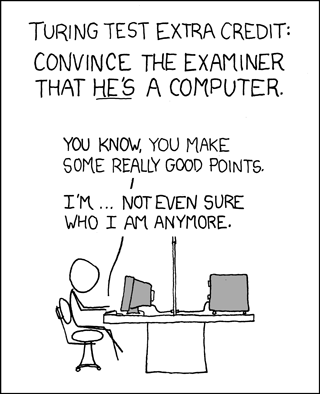
Hayles thus wants to examine how our relationship with increasingly pervasive technology, which is both external and now internal to our bodies, influences our understanding of reality. She brings up the example of the Computational Universe model, refering to Stephen Wolfram’s book A New Kind of Science. I find the idea that we are living inside a universe generated by computation processes fascinating, and also a little mind-blowing. (As always, xkcd has a relevant comic.) I also admit it is kind of attractive—though I’m not sure how, from a physics perspective, it might be testable. However, Hayles is neither endorsing nor refuting the Computational Universe model. Instead, she wants to prod it with a pointy stick:
I offer my own commentary on the Computational Universe, including a critical interrogation of current research claims. My primary interest, however, is not in separating the Computational Universe as the means by which reality is generated from its function as a metaphor for understanding natural and cultural processes. Rather, I am interested in the complex dynamics through which the Computational Universe works simultaneously as means and metaphor…. (4)
Ah-hah! This provides the segue into what Hayles calls “a fundamental question. What resources do we have to understand the world around us?” (5). She lists three broad categories: mathematical equations, simulations, and “discursive explanations.”
As a mathematician, I feel obligated to comment upon her critique of mathematics as a method of understanding the world. She has “little to say” except to point to others, including Wolfram, who claim that mathematics is of “limited usefulness … in describing complex behaviors” because these “typically cannot be described by equations having explicit solutions” (5). This is correct in the sense that, even if we develop the mathematics to model such behaviours, the lack of an explicit solution means we have moved from precise mathematical statements to approximations and models—i.e., we are now in the realm of the second category, simluations. Moreover, while mathematics is very good at describing underlying, fundamental systems, it’s also very arcane. That is, it produces accurate descriptions, but there is a significant investment required to understand those descriptions. Mathematics, as a tool for understanding complex systems, is limited by its own complexity.
Thus, what I think the other two categories share is a reductive capability. Both simulations and discursive explanations allow us to simplify, and we can measure the quality of these explanations by how accurate they remain, in terms of corresponding to observations, despite their simplifications. It’s easy to observe this in science classrooms the world over. We still teach kids about Newton’s laws of motion, even though Newton’s laws are wrong in the sense that they have been superseded by and are incompatible with Einstein’s relativity. You can’t derive Newtonian motion, which is absolute, from Einstein’s theories. Yet, it turns out that for very basic, simple purposes, Newton’s laws are so close an approximation that it doesn’t much matter. Hence, we still teach Newton’s laws because they have made the transition from mathematical equations that describe reality to discursive explanations of reality.
Hayles also highlights similarities and differences between these latter two categories. She cites Friedrich Kittler’s interpretation of reading as a type of hallucinatory experience:
Kittler’s proposition that reading novels is like a hallucination highlights one of literature’s main fascinations: its ability to create vividly imagined worlds in which readers can “hallucinate” scenes, actions, and characters so fully that they seem to leap off the page and inhabit the same psychic space as the readers themselves. In this respect, literature functions more like simulations than do other discursive forms, because like computer simulations … literary texts create imaginary worlds populated by creatures that we can (mis)take for beings like ourselves. (6)
This reminds me of a Neil Gaiman quotation I love:
Books make great gifts because they have whole worlds inside of them. And it’s much cheaper to buy somebody a book than it is to buy them the whole world!
And this interpretation of literature as encompassing imaginary worlds is also reminiscient of how, in some science-fiction literature, alien beings (including artificial intelligences) often have difficulty grasping the “human” concept of fiction. They do not understand that humans have developed an entire mode of discourse predicated on untruth that nevertheless refers to and can faciliate an understanding of truth. That’s us: good old, paradoxical humanity!
But Ben, you’re asking, what does all this mean in relation to the Internet? I think the Internet as an artifact might be something we can point to when we say we are already posthuman. Also, I don’t think it’s unreasonable to expect that, in the not-so-distant future, we will be able to connect our minds directly to the Internet. This would not lead to mind uploading per se, but rather an expanded mentality in which we remain embodied but aware of more than just what we perceive through our bodies.
Most importantly, however, I think the Internet is going to influence our norms of interaction, the way we perform our identities, and the way we view the identities of others. That is why I mentioned the OED’s inclusion of OMG, LOL, and “to heart” at the beginning of this post—the Internet is changing us, though we might not always be able to understand in what ways. Just as the mainstream adoption of telephones changed how we interact, now that people are using the telephone less and instead emailing, texting, and Facebook messaging, how we interact with others changes as our modes of interaction change. We even break up differently because of social media.
Don’t get too excited though. Recall that the majority of the world isn’t so tech-savvy or Internet-enabled. It is easy for us to get excited about the Internet and start examining how using it is going to change our definition of being human. What about all those humans who aren’t “network citizens?” If the Internet does become a keystone of our transition to the posthuman, does this mean that people without access to the Internet will be excluded? Will we see a “posthuman digital divide,” where part of our species becomes increasingly embedded within these technological systems and other part remains isolated? Or is it happening already?
I had a difficult time coming up with a further resource. So I hit up TED and looked for a relevant talk, and I found “Kevin Kelly on how technology evolves”. It seems applicable to the ideas we’ve been discussing for several weeks now, discussing what technology “wants” and how it develops and self-organizes its complexity. One line toward the end really strikes me:
Our humanity is actually defined by technology. All the things that we think that we really like about humanity is being driven by technology. This is the infinite game. That’s what we’re talking about. You see, technology is a way to evolve the evolution. It’s a way to explore possibilities and opportunities and create more. And it’s actually a way of playing the game, of playing all the games. That’s what technology wants.
If philosophers like Hayles are correct that we are on the verge of, if not already in, a posthuman future, then this question of “what technology wants” will be paramount.
I mentioned at the beginning of this post that I’m fascinated by depictions of posthumanism in science fiction. If you have the time, I highly recommend you pull down some books from authors who hit on posthuman motifs: Charles Stross, Vernor Vinge, Alastair Reynolds, Iain M. Banks, Peter F. Hamilton, Neal Stephenson, and of course, the inestimable Nancy Kress. What these authors do is important not because their futures are likely or even possible, but in imagining what it will be like to be posthuman, they set the stage for discussions of what we are becoming.
Is that a heterotopia in your pocket, or are you just happy to see me?
Let’s talk about porn.
Er, I mean, I didn’t just wake up today and say, “Hmm, I think I’ll write a blog post about porn.” Though that would be totally OK.
No, for those of you keeping score at home, this is my third critical response to a reading from my Philosophy & the Internet course. Last week we read “Pornography in Small Places and Other Spaces,” by Katrien Jacobs, first published in Cultural Studies, Vol. 18. A PDF version is available on her website. It’s an interesting article; go read it.
Back? Good. So, we‘re talking porn. Specifically, online pornography analyzed through the lens of Foucault’s heterotopias. Jacobs approaches pornographic sites as spaces online. She differentiates between place and space by drawing from Michel de Certeau’s distinction:
Whereas places are distinct locations and imply an indication of stability, spaces are constituted through movements and operations of bodies and minds.… De Certeau’s “spacing” allows us to conceptualize complex attachments and reflect on networked agency.
In this sense, we might be able to consider websites “places,” because they have distinct locations in the sense that, when one directs one’s browser to a static URL, one expects to visit the same page every time. This seems tenuous to me, however, and is belied by the complexities of the Web. It’s true that certain pages, like the one to which I linked above containing Foucault’s treatise on other spaces, are static. Most of the websites we visit in the course of our day, including porn sites, are dynamic. Pages are generated anew each time a visitor requests them; they include information about the visitor’s login status, the time of the day, recent activity by other users. All of these things are precisely the results of “movements and operations of bodies and minds,” and thus websites, distinct though they may be, are more properly thought of as spaces.
Jacobs contends that pornographic sites as online spaces have changed the power dynamics of the porn industry. Prior to online distribution, pornography was distributed and controlled much like any other entertainment venture: mostly by large companies that make deals with television networks, hotel chains, etc. The models of production and power were top-down, hierarchical, and dominated by white men in suits. The Internet provides a flatter model of production. Individual porn actors can create their own websites. This gives them direct control over revenue and allows them to interact directly with their audience, or as Jacobs says:
A number of women pornographers have equally started to build independent websites to have control over the exchange with their clients and create community-friendly commodity environment.
Also, this freedom in the production of pornography further encourages the “shift towards decentralization and heterogeneity” that Jacobs says characterizes the recent decades of pornography. Whereas porn distributed through more traditional channels tends to cater to “mainstream” sexual proclivities, the Internet provides a space where porn producers can target any number of fantasies and fetishes—and as a result, we have Rule 34. But we also get performances of pornography that are quite different from the traditional forms. Jacobs uses Francesca da Rimini’s characters and erotic tales that draw both from da Rimini’s experiences and Japanese folklore as an example.
Unlike offline porn, porn sites are spaces. Many of these sites are actually communities, where members can interact with the actors and with each other. For the consumer of porn, this creates an altogether different experience. Of course, this doesn’t mean the Internet is a panacea. The same capitalist agents present prior to online distribution are still present and still involved. This can result in tension when larger corporations begin absorbing the more “independent” and heterogeneous ventures, amalgamating them into a monolithic, more homogeneous entity (as in the case of PopcornQ merging with Gay.com merging with PlanetOut). The result is a potential for the Internet to “become a homogeneous environment that reproduces unequal conditions for access and participation.”
Indeed, the Internet for porn is not all fun and games. Jacobs talks a lot about censorship and the relationship between pornography, governments, and community organizations. Her observations remind me a lot of David Lyons’ “The World Wide Web of Surveillance” article (which was the subject of my first critical response). This is crucial to understanding porn sites as heterotopic. Tolerance for viewing pornography is conditional: generally, one must be an adult; nude photographs must be of adults, not children; and the time and place where one views pornography matters (no porn at work!). The conditions might vary across cultures, but their existence is what allows pornography to meet Foucault’s first principle (though whether porn sites are heterotopias of crisis or heterotopias of deviation is an interesting question).
With regards to censorship, Jacobs focuses on attempts to censor online pornography out of concern for the welfare of children. It is apparently too easy for children to stumble upon porn while surfing the Web. We can debate the propriety of exposing children to pornography, of course. (Personally, I find the campaign to maintain children’s ignorance under the guise of “innocence” abhorrent and disrespectful towards our children’s development. Our society is geared toward sex, and it’s not as if you magically notice that when you turn 18. We might as well admit it while they‘re young and teach them how to deal with it.) Regardless of one’s position in that debate, the debate’s existence belies the classification of online porn as heterotopic by definition. There is plenty of free porn available online, and depending on how well the search engine filters perform, it can be easy to stumble upon porn unintentionally. So online porn in general cannot satisfy Foucault’s fifth principle.
But that was never the claim. Rather, the Internet offers a way to distribute porn through different types of porn communities, whether they are portals managed by large companies or smaller sites run by a single porn actor, that function as distinct spaces within our society. These spaces are heterotopic. Let’s run down the list of Foucault’s principles:
- It’s possible to view porn sites both as crisis heterotopias and as heterotopias of deviation. One visits porn sites when one is in a mood to do so. Porn sites provide a convenient space to relieve one’s sexual desires, an act for which we designate private or intimate spaces. On the other hand, there is a porn site to satisfy any type of deviant or non-normative sexual desire one might have.
- They have a specific function, which has changed over time and will continue to change as our relationship with the Internet changes.
- Much like theatre, porn sites bring several elements of “real” places together, often in surprising combinations, in the pursuit of erotic journeys and fantasies.
- The heterochrony of a porn site is a kind of idealized slice of time in which the actors are in their prime, at the peak of their health, performance, and prowess. (This does not necessarily mean everyone is young, per se, but everyone, regardless of age, exudes youthfulness and vitality.)
- Unlike random pornography just circulating online, porn sites are usually behind paywalls, so there is an economic barrier. Only adults are legally allowed to access those porn sites, and theoretically the economic requirement of possessing a credit card is supposed to enforce this. Finally, there are many social conventions about when it is appropriate to browse porn. For example, workplace policies prohibit surfing for porn at work. Couples will have varying protocols about the appropriateness of accessing porn alone or together.
- Ultimately, of course, porn sites are a space of illusion. They complement our reality by reifying our fantasies. We seek out enactments of fetishes that cannot (should not) ever be realized in real life.
I found one phrase in Jacobs‘ discussion of censorship particularly striking in the context of our discussion of heterotopias:
The debate … is still going on today and questions if community standards of decency can be transferred from place to place.
I find this question fascinating. It recalls our discussions of the Internet’s relationship with geography and Manuel Castells’ interpretation of the network society. It seems to me that the answer to this question is probably “no,” although that answer itself probably requires qualification, and as noted above, it’s still open to debate.
Now what if we replace “place to place” with “space to space” and look at the Internet’s relationship with spaces? I think it would be very easy to read only as far as “heterotopias of deviation” in Foucault’s writing and respond to the revised question in the negative. Yet it’s a little more complex, isn’t it, because in his third principle Foucault describes heterotopias as “juxtaposing in a single real place several spaces, several sites that are in themselves incompatible.” This suggests, to me, that a heterotopia should be able to juxtapose multiple standards of decency. Indeed, two consumers on a porn site might have differing standards of decency and only consume those aspects of the site that meet those standards.
So the original question attempted to use geographical place as a context for debating Internet censorship. The ACLU objected that a blanket federal law would require us to censor according to a conservative common denominator, if you will, while proponents of censorship maintained that community standards about porn might vary across cultures but not when it comes to exposing children to it. All of these arguments engage with porn sites and the Internet as places, and as we‘ve seen in previous weeks in this class, the Internet’s relationship with physical geography is complex and not necessarily straightforward.
If we instead consider the debate in the context of spaces, which seem a more apt model for the online environment, then does the phrase “community standards” even have meaning any more? After all, what “community” are we talking about? I‘m struggling a little here to convey the question I’m grappling with, but I suppose one way to express would be: how does our interpretation of porn sites as heterotopias affect this question of censorship? I‘m not sure if that’s exactly the issue I‘m trying to raise when comparing these two different ways of viewing the Internet and porn sites.
I don’t see it mentioned on the course Moodle site, so I’ll recommend a look at Katrien Jacobs’ blog in general. There are links to other articles she’s written and excerpts from a forthcoming book.
When I think about porn and the Internet, Peter Nowak comes to mind. He’s the author of Sex, Bombs and Burgers: How War, Porn and Fast Food Created Technology As We Know It (and wow, my Oxford comma hindbrain is twitching right now). I have not yet read his book (it’s somewhere on my hideously detailed and lengthy book), but I’ve been reading his blog for a while now, and he was interviewed for Spark as well. Nowak discusses the role that the porn industry plays in technological innovation. Of course, the Internet is one of the major innovations of our era, so if his thesis is correct, the porn industry has a significant effect on it as well. Although what I‘ve seen of his writing so far doesn’t draw explicitly on the notion of heterotopia, Nowak’s ruminations on porn are very holistic in the way he considers our relationship with porn spaces. For example, he has linked the US Library of Congress decision to allow iPhone jailbreaking to the return of porn to the iPhone and offered his opinion on what this means in the context of mobile phone spaces. Forget the computer, we can have porn on our phones now! And with phones increasingly becoming smart, they are no longer just devices but spaces in their own right (or at least, interfaces allowing us to engage in other spaces). As a society we are exploring how best to negotiate these spaces—whether we prefer more “closed” environments like Apple’s app store or “open” environments like those of another platform. If Nowak is correct, our attitudes toward porn and the porn industry will have an impact on how we engage with these spaces.
Rather than include a single pithy image at the beginning of this post, as seems to be trendy in the blogosphere these days, I’ve interspersed a couple xkcd comics abour porn, courtesy of their CC-BY-NC license. I leave you now with one more, which is relevant both to last week’s discussion and our previous week’s discussion about performance and the queer:
(By the way, Porn for Women is a real book. From what I glean from the Amazon page and their website this is a satirical endeavour that likewise tackles issues of gender stereotypes. Nevertheless, I still think the comic is relevant and entertaining.)
Submission to the legislative committee on Bill C-32
Today is the last day that the House of Commons legislative committee on Bill C-32 is accepting submissions regarding possible amends to Bill C-32, our latest attempt to amend the Copyright Act. What follows is my submission to them. It is definitely not very formal and contains no real proposed amendments—many more knowledgeable people have already made such submissions, and I defer to them in that area of expertise. Nevertheless, I felt that it was important to have my voice heard.
Dear Legislative Committee on Bill C-32,
I am not a pirate.
Hard to believe, I know. The current draft of Bill C-32 seems to imply that piracy is rampant in Canada, and in particular among the demographic to which I belong, that of the 18–34-year-old university student. Curiously enough, this perspective corresponds to the one advanced by the industries who distribute music, movies, and media, the very industries who are now complaining that Internet piracy is destroying their business model. While I expect such heated, anti-consumer rhetoric from those industries, who after all are obligated by their shareholders to demonize and portray consumers as immoral beings who will only partake in legally-provided media if they have no other option, I expected better of the Canadian government. My grade 10 Civics class taught me that the government is supposed to recognize the will of the people, not the will of the special interests lobby.
But this is not about the inaccuracy of information in our education systems. This is about Bill C-32, a long-needed overhaul of our outdated Copyright Act. I commend the government for taking on this daunting task. Finding a balance between the interests of consumers and creators is not easy, but it is balance we need. So, I am pleased that you have asked for input from Canadian citizens regarding the current draft of this bill. Were you aware that your esteemed colleagues at Industry Canada consulted Canadians in the summer of 2009 on the previous proposed amendment, Bill C-61? That consultation received over 8000 submissions, 6000 of which were opposed to Bill C-61 and to digital rights management (DRM) locks in general. So, forgive me if I feel like I‘m repeating myself, but I’ve already been through this once.
I am not a pirate. I’m not even a so-called “radical extremist.” I have no desire to eliminate copyright altogether—as a creator myself, I too enjoy the protections that copyright law provides for me. Nevertheless, unlike certain representatives of special interest groups, such as SOCAN and CRIA, I am not naive enough to think that we can blithely continue to the reality of copyright in a digital age. The Internet is a fundamentally new media when it comes to distributing information. The cost of distribution is now effectively zero. Copyright can no longer be about “who has the right to distribute,” because this going to happen anyway. There is no DRM lock that cannot be picked. There is no technological protection measure (TPM) that cannot be circumvented. And so, if you enshrine Bill C-32 as “the digital lock law” and attempt to protect Canadian creators by locking down their creations, you will fail.
You will fail, because I am not a pirate, but other people are. And this bill will not stop them. It won’t even slow them down, not for a minute. Law-abiding citizens like myself will respect it, of course, and we will be stuck in the slow lane of the Internet, waiting for American television shows to come across the border, waiting for a new single to come out on iTunes, waiting for that Brand! New! Movie! with that Hot! Young! Actress! (you know the one I’m talking about) to come out on DVD. We, the law-abiding public, will be waiting, while the pirates will be busy downloading media, not paying for it, and chortling over the incompetence of the Canadian government.
Stopping piracy is a laudable goal, but let us be realistic. You cannot legislate piracy out of existence—by definition, it exists as a reaction against the legal avenues of doing business. And as long as you persist in making Bill C-32 about stopping piracy, about protecting the distributors and, to some extent, the creators, about expressing a fundamental distrust in the electorate of this nation, then you will fail. You will fail, because I am not a pirate, but under the new legislation, I might have to become one. I try my very best, every day, not to pirate media. I do not download songs; I buy them on iTunes. I do not download movies; I record them on my DVR (is that even legal?) when they come on cable television. I do not download books, though I am an avid reader, but instead I visit the library, or I purchase them new as a show of support for the author. I try so very hard, and you are not making it any easier.
I am not a pirate, nor do I want to be. So why not make it easier? Instead of focusing on all of these negative aspects of digital distribution, why not create proactive legislation that encourages the innovation of business models at a digital level? Make it easier for companies like Netflix and Pandora to open their doors in Canada. Make it easier for Canadians to download and stream music, movies, etc., legitimately. Because if you do that, then most Canadians will act in good faith. Most Canadians won‘t pirate but instead pay, because contrary to the opinions expressed by the special interests groups and the lobbyists for the industry, we are not all immoral.
We are not pirates. Most of us don’t even have a Vitamin C deficiency. We are people, and we want our media, and we want it now. Because the Internet is all about instantaneous access to information, and maybe that has spoiled us. Nevertheless, it is reality. The new reality. And passing legislation that ignores this new reality in favour of a rose-coloured glasses version painted by the industry is silly. Copyright can no longer be about “who has the right to distribute,” because our ability to restrict that is gone forever. Instead, copyright needs to be about “who has the right to reuse.” Who has the right to remix, to modify, to make a profit off this material? These are the questions that you, through Bill C-32, have a chance to answer. I am not so convinced you have answered them to anyone’s satisfaction.
Look, it’s not all bad. The expanded fair dealing sounds really good. And I am pleased that Bill C-32, if not perfect, is not quite as insistent upon digital locks as its predecessor was. Whereas Bill C-61 was untenable, something I could not abide, this one is much more workable. In its present form, it is not ideal, but I definitely think that, with a few amendments, you could produce a copyright bill that strikes the right balance. Canada could be an example for the rest of the world of a modern country with modern copyright legislation that takes into account reality, that protects consumers, that protects creators, that encourages digital innovation. Or, you could follow the USA, make a “Canadian DMCA,” and watch piracy continue unabated.
It’s your call, really. I have done my part—twice over, once in the summer of 2009, and now in the winter of 2011. I have worn my fair copyright T-shirt; I have encouraged my fellow citizens to speak out on this issue. But you are the ones who have to listen to us. Listen to us, and hear our concerns. We aren’t asking for anything unreasonable. We aren’t asking that you let us copy entire textbooks for whole classes of students, or that we get to go into a Blockbuster and rip movies from DVDs onto our computers. All we are asking for is fair, balanced copyright legislation that works for us, here and now. So think about it.
The federal government hates blind people and web designers
Originally I was just going to tweet a link to this CBC news article and leave it at that. The more I thought about it, however, the more outraged I became. I‘m not sure why. Maybe it’s out of some need to feel vicariously oppressed, on account of the fact that I am a tall white male and thus systemically unoppressed. Maybe it’s because, although I am not a professional web designer, I am familiar enough with the field to weep over the attitude displayed here by the government. It is 2011. Last December, the Web turned twenty years old. And we still can’t support blind users? Seriously?
That is what the federal government says. Apparently, rather than spend taxpayer money to pay web designers to update its websites, it would rather spend that money paying lawyers to appeal this court decision. Rather than offer equal services to blind users, it would rather go to court and spend our tax dollars to ensure it can continue discriminating. The government is making us accomplices to discrimination. And here I thought I lived in Canada, not the United States.
I am taking a Philosophy of the Internet course this term, online of course. I’m so excited for it, because the Internet excites me in general. I look around and see all the change that the Internet makes possible; we are living through exciting times, and the world is never going to be the same thanks to the Internet. Not all of this change will be for the better, but when is it ever?
So it pains me that, twenty years after the inception of the Web, there is still a deeply-entrenched attitude among corporations and governments that somehow the Web is not essential and that not everyone need have access to the Web. Increasingly, however, we are seeing more services move to an online platform. If the Web is not essential now, it soon will be. But you know what? According to the government, if you can’t see, then tough luck:
Government lawyers had argued there was no discrimination because those same services are provided in other formats, such as on the phone, in person or by mail.
That’s right: the Web is for sighted people only. That seems to be the stance implicit in this argument, that “other formats” will be available for those people who happen to be visually-impaired. No, no, don’t bother asking the government to make its websites accessible. People with disabilities don’t matter.
There is a word for this behaviour: disgusting.
As an amateur web developer, I pride myself in being aware of Web standards and striving to implement them as faithfully as possible. Fortunately, because I do not get paid by corporate clients to build them websites to which millions of users will flock, because I do not provide any great service to the public, if I happen to make a mistake and render my website inaccessible to blind people, it isn’t a big deal. (And if you are blind and trying to read this and your screen reader is rebelling against you, please let me know so I can try to fix it.)
I don’t think we should let the government just shrug like I can and say, “No big deal, go use the telephone.” Making websites accessible to the blind is not, for the most part, difficult. It requires effort, and depending on what type of data you want to communicate, some creativity. Somehow, I think the ultimate cost of adding that accessibility to its websites would be less than the court costs involved in appealing Justice Kelen’s ruling. More importantly, the government has an obligation to serve its citizens—all of its citizens—and I reject on moral grounds its argument that alternative formats are an excuse for having inaccessible websites.
This is just another incident that underscores our government’s inability to keep pace with the development of life in a digital age. Canadians still have woefully inadequate broadband penetration, something the Conservatives have done little to rectify—and while the Liberals promise more, I don’t believe they would do a much better job. All of our parties are mired in pre-digital perspectives. They are too afraid or too corrupt to take on the telecommunications companies that dominate our Internet and mobile services and squeeze out competition at the price of innovation so that they can make more profit.
In the end, it isn’t just blind people who lose. It isn’t just web designers. It’s everyone. The rest of the world moves forward, and Canada will be left behind in the digital dust. Because our government doesn’t care.
Swype: The compromise between QWERTY familiarity and touchscreen elegance
Back in grade four, something miraculous happened. Our class at Isabella Street School descended down to the library, which was nestled in one corner of the unappealing, rather dingy cement and concrete basement. I already loved the library, and reading in general, by that time. It was through this library that I devoured those Hardy Boys books that my dad did not have, read my way through Nancy Drew, had my first experiences with Tolkien and Lewis and, in later years, Agatha Christie. There were several shelves full of colourful books on mythology when I went through that phase, and even a pop-up book about Star Trek, a copy of which I bought for $10 on Abebooks during a bout of nostalgia in the summer, which has not actually arrived yet, and now it occurs to me I should probably ask someone about that….
But I digress. On that fateful day, my grade four class was not there to browse the bookshelves and sit at our octagonal tables in chairs now much too small for me. No, we instead turned left at the doors to populate the “computer lab.” This must have been 1998 or 1999, so the computers were all still MS DOS, although they had this nifty feature where you could “boot into” Windows 3.1. (Even back then, I was pretty adept at getting the system to do what I want, if I do say so myself.) We had all the cool games back then: Treasure Mountain, Cross Country Canada (both of which I now have on my computer, and play using DOSBox), and, of course, Math Circus. Unlike other visits to the computer lab, however, we were not there to play games.
We were going to learn how to type.
We learned using the Almena method. I think we watched some videos, and there was a retired teacher and expert typist who volunteered at the school and helped our teacher instruct us. I still remember the mneumonics to memorize the placement of keys: “Quick Ask Zoe, What Stops X-rays, Even Dogs Can‘t. Red Fish Vanish, Then Grow Bigger. Yaks Hear Noises, Under Jack’s Mattress. I Keep commas, Over Long periods. Peanuts!”
It sounds a little silly, doesn’t it? But for those of you who used this method, you know what I’m talking about: it really works. And as my rendition above attests, for I did not have to look those up, I still remember those mneumonics after all this time. It is inculcated into my very being. I didn’t realize it then—I did realize how cool being able to touch type was, but I didn’t realize how much a part of me this ability would become.
It’s like having a superpower. That is the only way I can describe it, especially to those few people reading this who themselves have never learned to touch type. On a good day, I can type about 100 WPM (less if I‘m pausing to consider what I shall write, as I am doing now). Like many people, I use a computer every day, and I spend a great deal of time on my computer. So typing is an essential skill for me. Looking back, after a decade more experience, I am very grateful that my elementary school, or the curriculum, or whoever was responsible for that decision, chose to teach me how to type.
Oh, I’ve dabbled with alternative keyboard layouts, like Colemak. But I‘ve always returned to QWERTY, that faithful keyboard mistress. Why? Because it’s a part of me. Colemak is, in my opinion, a much superior layout, and I enjoyed using it. But the QWERTY school got to me when I was young, indoctrinated me, and now I can’t escape.
And it’s only natural, with such a dependency on this interface, that we begin to port it to other devices once they need text-input capability. After all, QWERTY itself is a port from typewriters to computers. Now we have QWERTY keyboards on so-called “quick messaging phones,” as well as smartphones. But is this really the best way to type on a phone? The small screen means either a keyboard with physically smaller keys or a rather daunting, at least at first, touchscreen keypad—and let’s face it, you’ll be typing with your thumbs either way. Given time and practice, people do tend to master it and become proficient. But is there any better alternative?
That’s what Swype offers. I was skeptical at first: so you swipe (hah) your index finger along the QWERTY keypad, passing through each letter in the word you want to spell, then Swype predicts the word you want? Sounds too much like that abysmal T9 software that came on my former phone! But no, it’s completely different. And it’s rather awesome. Watch some of the videos. It is impressive how fast you can get; I’m not nearly that fast yet, unfortunately.
Swype is in beta, and it was just recently released to the general public. I was lucky enough to have it pre-installed on my new Samsung Galaxy S. I was drawn to it for a simple reason: the default Samsung keypad, which replaces the apparently perfectly capable Android keypad on most other Android devices, sucks. Samsung has crippled essential functionality—in my case, a strong need for accented characters and diacriticals. Swype, in addition to its unique input method, restores my ability to use accented characters with ease.
So I switched to it, and at first I just typed on the keypad like normal (because you can do that). However, the keypad comes with a tutorial, and I decided to go through it and see what the hype about Swype was. The idea of swiping through letters is intriguing, and it does seem a lot nicer than thumb-typing. Indeed, Swype shines most in portrait mode—prior to using it, I had a lot of trouble typing on the skinny keys in portrait mode; landscape was and is not much of an issue. With Swype, I just slide my index finger around, and that’s it.
Of course, deliberately smudging my screen while typing seems a little wrong. Then again, “dragging” icons and images around the touchscreen is a perfectly acceptable user interface mechanic, so this is not that much of a departure. The most serious obstacle I have encountered lately is a lack of lubrication on my fingers; if they are too dry, there is too much friction against my screen, so swiping through keys becomes both slow and rather uncomfortable!
Nevertheless, on a conceptual level Swype makes a lot of sense for smartphones. I‘m not sure it would work well for larger devices, like desktop workstations, although you might be able to make a case. It is interesting to see people come up with new input methods that capitalize on the benefits of a capacitive touchscreen (dragging/swiping fingers) to mitigate a disadvantage of the device (small screen size, small keyboards). And Swype is still QWERTY, so the layout of the keys haven’t changed, nor are you forbidden from touch typing as per usual, which makes the learning curve virtually nothing. It may indeed be a good compromise between the backward compatibility to which QWERTY has enslaved us and the need for innovation in input on smartphones.
Anyway, that’s my Android thought for today.
Old and busted/New hotness
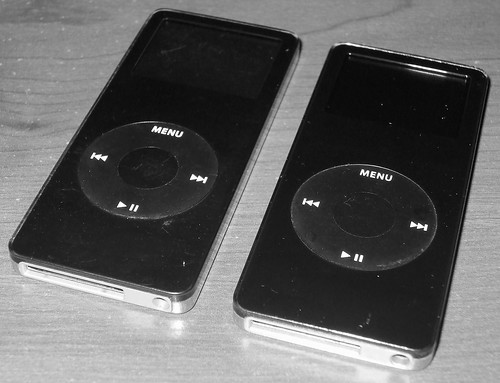
No, what you see above is not the result of an evil exercise in cloning first generation iPod nanos. I do indeed have two. Here’s why.
Last week after I arrived home from work, I dropped my iPod. It landed butter-side-down on the asphalt driveway with a dull, unassuming thud. Immediate inspection revealed no damage to the exterior, but when I turned it on, only the bottm left quadrant of the screen was working. I had broken my iPod.
This was my first MP3 player, bought in the summer of 2006 for the 20-minute bike ride to and from work. Sure, it’s only got a gigabyte of storage, but that has always been enough for me. Even as newer models came (and went), I stuck firm to a resolution that I would not upgrade until my iPod itself would no longer do what it was designed to do: play music.
A broken screen did stop my iPod from playing music, incidentally, and at first I thought that was the extent of the damage. Although this was inconvenient—I could no longer see how much of the battery remained, for instance, and selecting songs became an art instead of a science—it still played music, and that’s what I needed it to do.
The fall must have damaged to the battery as well, because I charged it up that night, and when I turned it on in the morning, it gave me a “very low battery” warning and shut off. Since it refused to hold a charge, I had no choice but to declare my iPod nano dead.
So then I had a dilemma. What do I buy to replace it? There’s a myriad of MP3 players on the market, and although I’m a tech-savvy person, most of them are close enough in terms of features that it’s so very hard to make a useful comparison. It mostly came down to price: aside from the shuffle (which has no screen), the new iPods start at $150. There were some other brands that cost half as much, but I still wondered if they cost too much. In the end, my decision didn’t come down to price so much as features—and not the features I wanted, but the ones I didn’t want.
Imagine my surprise upon learning that the latest iPod nanos (fifth generation!) have cameras in them. Now, I have nothing against putting a camera in a device. That’s great. But I don’t really need to pay the extra money for an MP3 player with a camera when I can get a comparable one without a camera for a little less. Come to think of it, I really don’t need anything from the MP3 player except for it to play music and have a screen so I can select songs. What I really wanted was my first generation iPod nano.
So I got one. I went on eBay and easily found an auction for an iPod identical to mine—only it was 2 GB instead of one. So it’s an upgrade! It cost me $37 with the shipping (my original 1 GB iPod nano cost me over $200). It arrived today, so I snapped a photo of my two iPods together. I love continuity—in fact, I crave it. I would have kept my old iPod for as long as it kept going, and I’m a little frustrated I lost it to something as incidental as a fall. It has served me well, and even though I have a new one that is identical … I still miss it.
Sure, it’s not the newest model, and it doesn’t have umpteen gigabytes of space. That’s fine for me though. Unlike a mobile phone or computer, I don’t need any new features in my MP3 player. I want it to play music. The extra space, compared to my old one, is nice too. But it’s the comfort this continuity brings (and at a fraction of the price of the original) that matters. My first generation iPod nano is dead.
Long live my first generation iPod nano!
My doomed love affair with the Kindle
Some big news in the Canadian tech industry this week was the advent of the Amazon Kindle in Canada. I’ve mentioned my mad love for the Kindle previously as well as my discomfort with Amazon’s approach to tethered appliances. So, now that the Kindle is finally available here, will I be getting one?
The short answer is no, not right now. Technologically, I think the Kindle is an amazing device that uses some pretty interesting physics to make reading easy and comfortable. It boggles my mind that we have the ability to store so many books in such a small, slim shell and take it anywhere with us! However, I still have reservations about whether an e-reader is necessary, and I’m still set against tethered appliances. So here’s the long answer.
One More Piece of Luggage
When you leave the house, what do you check to make sure you’ve got with you? Keys, mobile phone, ID, maybe money? What about your Kindle?
I’ve got this bizarre notion that, if I one day get a smartphone, I could use that device as my e-reader as well. It makes sense to combine them; we‘ve already rolled music players and cameras into our phones. It’s one less device to worry about forgetting at home—or worse, elsewhere.
Of course, the Kindle (and other e-readers) are superior technologically for reading books. Their screens are designed to make it easier to read, and their battery life will probably last longer if you‘re just flipping pages. I can see how an e-reader would be a sensible investment for someone who doesn’t want or have a smartphone. And I don’t deny that some part of me wants an Amazon Kindle.1 I‘m just not convinced that it makes the most sense.
The Ol’ Ball and Chain
No matter how attractive or sensible the Kindle may be, it’s still tethered to the home office. Like the sleek and shiny iPhone, the Kindle is loyal to its manufacturer, not to you, the consumer. When you buy the Kindle, you’re just buying a device that’s a gateway to all the other content Amazon wants you to view but not own. The Kindle is a gateway drug.
Amazon demonstrated the draconian way it can manage Kindle content in July, when it deleted illegal copies of 1984 from people’s Kindles. To Amazon’s credit, apologies were made, and an Amazon spokesman assured us that it would never happen again—that, in fact, changes would be made so Amazon could no longer delete books remotely. It’s still a sobering reminder that, despite your physical possession of the Kindle, it isn’t really yours.
I‘m aware that the Kindle can read multiple formats, including yummy plain text files from Project Gutenberg. Yet the Kindle’s main goal is to persuade you to buy “Kindle editions” of books you want to read. These are proprietary files that only authorized devices can read, whereas a plain text file is readable by any number of devices. There are two problems with this. Firstly, it allows Amazon to control when and where you have access to the book you purchased. Secondly, it raises the spectre of data loss—since only Amazon-authorized devices can read the Kindle format, what happens if Amazon disappears? Unlikely, but still possible. Realistically, there are ways to cirumvent the DRM protection on the Kindle format and retrieve one’s data, but they aren’t legal, which leaves you in the interesting position of having to break the law to get at content you bought. An open format is safer when it comes to preserving and backing up.
I‘m using the Kindle as an example because of its release in Canada, but Amazon is not the only company doing this to its e-readers. Sony, whose Reader line has long been available in Canada, also has a DRM format. And when Barnes and Noble’s e-reader comes out, I‘m sure they’ll have a proprietary format as well. This isn’t the exception but the rule. And it’s up to us to change that.
Why? Well, Amazon, Sony, and B&N are doing what they think is best for their bottom line. They don’t want freely available, easily re-distributable books that will cut into the profit margins for themselves, for their publishers, and for their authors. I understand the desire to cut down on privacy, but we’ve been down this road before. There’s a reason that recording labels have finally agreed to drop DRM from iTunes. These bookstores, like the recording industry and the newspaper industry, are clinging to an outmoded idea of copyright and redistribution. Amazon, as a solely online venture, should know better. Clearly it doesn’t.
In Which I Return the Soapbox to Its Rightful Owners
So that’s why we, the consumers, need to show that this isn’t the model we want.2 Or at least, that’s what I think. I don’t know. Sometimes I feel old and codgery. I‘m a technophile who refuses to get a smartphone because I’m holding out for something that runs Google Android, and I refuse to change to a carrier that does offer an Android device because the competing carriers in Thunder Bay have ludicrous service and pricing compared to TBayTel.
Maybe I should just get off my high horse and admit that yeah, the Kindle is pretty darn awesome and I‘d love to have one. But I can’t do it. I just can’t. I could probably surrender on the smartphone front, one day, if I so desired. This is different.
This is about knowledge. Books are one of the most precious resources of knowledge we have, and I will not be party to locking them away under the guise of “copyright protection” and “digital rights management.” I will not be complicit in the gradual erosion of the public domain, nor in the partitioning of content by format and fiat.3
If you‘re new to this debate and want to learn more, I’ll point you to the (somewhat biased) work of Cory Doctorow, Michael Geist, Lawrence Lessig, and Jonathan Zittrain, great advocates for a more open Internet.
I’m going to go read a non-DRMed book.
- [ 1 ] The three-year-old, “I want it! I want it! I want it!” part.
- [ 2 ] Yes, I‘m advocating that we let the free market decide. I’m not totally socialist!
- [ 3 ] Twenty years from now, assuming this blog hasn’t been locked away behind some proprietary wall, the cynical Future Ben will look back at Present-Day Ben and shake his head at Present-Day Ben’s naive idealism. But until that day comes, I’m allowed to be as naive and idealistic as I like!
Last updated Thursday, October 14, 2010 at 11:22 PM
Windows 7 is Windows Vista After Rehab
My copy of Windows 7 Home Premium arrived on Friday. On Sunday night, I began doing some housekeeping on my computer to prepare for the upgrade: I uninstalled programs I was no longer using, cleaned up unnecessary files, defragmented, etc. To finish it all off, I decided to finally delete that 10 GB recovery partition Dell put on my computer when I bought it. I‘ve never used it and probably will never need it, so I got rid of it.
That was a mistake. Or rather, I didn’t anticipate the problems it would cause, which was my mistake. When I rebooted the computer, rather than faced with the choice of booting Windows Vista or Kubuntu 9.04, I saw “Grub Error 22,” and my heart skipped a beat. I had killed my boot record!
The good news in this situation, of course, was that my filesystem was intact. I cast about for the Kubuntu 9.04 Live CD from which I had installed Jaunty back in April … and couldn’t find it. Fortunately, I did find the CD for Kubuntu 7.10—old, but perfectly usable. I booted into Gutsy Gibbon and verified that yes, my Windows installation was intact. I just couldn’t boot it, and that was the problem I tried to resolve. Alas, I couldn’t get to Grub’s configuration file—I couldn’t access any of my Kubuntu installation. Nor were attempts to reinstall Grub successful. In fact, everything I did seemed to make the situation worse.
So I did what we all do when we hurt our computers: lowered my standards. No longer was “reinstall Grub” on the list; now I would be content to just restore the default Windows boot record. I planned to do a clean install of Kubuntu 9.10 anyway, so I decided that this was no large setback. The instructions for repairing the Windows boot record with my Kubuntu Live CD did not work. I tried the recovery CD I had received from Dell, but it only offered the option to re-install Vista from the factory defaults.
At this point, I remembered that I had a Windows 7 installation DVD sitting on top of my printer. If I had to do a clean install to fix the problem, I might as well install Windows 7. I had backed up all my important Windows data via Kubuntu already, so perhaps this would actually give me a “fresh start.” I booted from the Windows 7 DVD …
… and below the option to install was the option to “repair.” I was elated. Upon selecting this option, I sat back and watched as the DVD searched for a Windows installation, found Vista, detected that the boot record was bad, and asked if I wanted to fix it. After a frantic click of the “Yes!” button, I watched as Windows 7 saved me before I had even installed it.
So I might be a little biased when I agree with those who think Windows 7 is a great operating system.
I performed the actual upgrade on Tuesday night, and as soon as I had persuaded the DVD that my laptop was compatible (it kept on giving me silly error messages) the actual install was a snap. It took about four hours, and when it rebooted, all my data was intact (a plus) and everything worked like it should. So I delved into Windows 7 to discover what I liked and what I didn’t like.
I love the new Libraries feature. It’s a sensible way to collect disparate folders with similar roles. You can completely customize your libraries, and when you combine them with the “jump list” feature from the taskbar, you‘ve got near-instantaneous contextualized access to your files.
Speaking of which, I have mixed feelings about the taskbar. I’m not sure if I like the compacted icons for each active application (I am aware I can disable this layout and use the default, Vista-style one, but I haven’t done this yet). I do like that the Quick Launch bar is gone; you can just “pin” applications to the taskbar like you can do to the Start Menu. Windows 7 has done a lot to reduce redundancy.
I did end up disabling User Account Control. I know, I know, it’s not safe! But it annoyed me to no end only ten minutes into exploring Windows 7. I even tried turning it to the lowest notification setting, but all my attempts at diplomacy failed: UAC was out to get me. So I killed it. I confess. Take me away!
Some of the new icons are a bit ugly, but there’s probably a way to customize that if it’s a dealbreaker for you.
Recall that I actually liked Vista. If you didn’t like Vista, you might need to overcome that hurdle before you warm up to Windows 7, which is essentially Vista on steroids. Still, Windows 7 does address the major problems of Vista—it’s Vista without Vista’s annoying idiosyncrasies. It’s Vista after rehab.
I’m not even going to try to compare Windows 7 with other brands of operating systems. If you’re a steadfast Mac or Linux user, Windows 7 won’t make you change your tune, and I don’t mind. I still hold to the hope that one day I can use Kubuntu more than I use Windows, but until that day comes, it’s good to have a Windows installation that works with me more than it works against me.
Now if you excuse me, I need to go compulsively organize my documents into Libraries… .
Welcome to the Walled Web 2.0
As much as I am in love with the technological achievement that is the Amazon Kindle, I have to chastise Amazon and the producers of other eBook readers for what I see as a step backward.
You may have heard last week about Amazon deleting books off Kindles. This is worrisome because—as Jonathan Zittrain explains—it emphasizes how much you don’t own what you “buy” from Amazon or any other company that digs its claws into you by selling you tethered goods. We sacrifice our freedom to keep what we purchase in return for a little convenience in the purchasing.
That’s not all though. Barnes and Noble, bookstore rival to Amazon, plans on launching its own eReader from Plastic Logic. Now, I’m all for competing eReader devices and competing eBook stores. Competition breeds innovation. But what I don’t like is this:
At this point, B&N’s plan becomes clear—the books will be tied to the B&N e-reader, and not downloadable by Kindle or Sony Reader owners. Essentially B&N is trying to set up a closed ecosystem that’s a direct rival to Amazon’s, and that’s based from its bricks and mortar stores and a website, versus Amazon’s 100% cloud-based solution.
A synonym for “closed ecosystem” would be “proprietary network.” This harkens back to the early days of the World Wide Web, when the Web consisted of disparate service providers like CompuServe and Prodigy. Rather than buying the eReader right for me and then buying books from various online sources, I’m going to be locked into a single provider for my content—and apparently they have the right to veto my access to that content, even if I‘ve paid for it.
(To the credit of Barnes and Noble, their eBooks will not be restricted just to their Plastic Logic eReader. According to the Fast Company article to which I linked above, they will also have software available for the BlackBerry, PC, and of course, the notoriously proprietary iPhone. This is one step up from Amazon’s strategy with Kindle eBooks, I suppose.)
I understand why stores like Amazon and Barnes & Noble are doing this. They’re just trying to make a profit. And part of me wants to say, “OK, try it your way, and see if this works.” Yet I worry that such an attitude will do more harm than good, especially for authors and publishers. I sincerely doubt publishers will ever make much money on eBooks. The role of eBooks is in publicity, in attracting new fans and moving physical versions of the book—because rest assured, physical books aren’t going to disappear as eBooks gain popularity. Give the digital copy away for free, then charge for the hard copy.
Critics contend that this model is unrealistic: after all, then everyone with an Internet connection will just download the free copy and the publishers and authors would lose money! I somehow doubt that. Firstly, I much prefer reading books in hard copy, and most readers share this sentiment. Even improvements to eReaders to make reading more comfortable (such as the e-ink screen on this generation of eReaders) will never equal the feel of a bound paper volume in my hands. Secondly—and I‘m sure you’ve noticed this yourself—having easy access doesn’t automatically mean I’ll take advantage of it. I currently have easy access to 30,000 free books from Project Gutenberg. Guess what I‘m doing right now? That’s right, I‘m not reading a single one. Because I’m lazy. On the other hand, if I‘ve got a physical copy of a book on my shelf, I have an impetus to read it.
But hey, maybe I’m just a dreamer. It’s not my job to come up with new revenue models, just to shoot down existing ones!
Incidentally, if you’re looking for more information on this subject, check out Jonathan Zittrain’s The Future of the Internet—And How to Stop It, available for free download under a Creative Commons license. And if you like the book, buy the hard copy version. 
What We Learned from #amazonfail
I quite enjoyed on Easter weekend watching the instantaneous outrage across the Internet, particularly #amazonfail on Twitter, as it became apparent that Amazon had removed sales rankings from books with “adult” content. The outrage stems more from the fact that the application of the “adult” label seems skewed toward books with homosexual content; the heterosexual books are safe. In the ensuing light-speed confusion: Mark R. Probst shared his limited interaction with an Amazon rep, in which the rep revealed the “adult content” policy; the LA Times book blog covers it, then covers it again when sources claim that Amazon has blamed a “glitch”; and some posited it was the result of gaming the system.
Take the time to read the above articles before reading on.
What Definitely Happened
In lieu of any definitive statement from Amazon regarding this debacle, it would be irresponsible to say, “This is what happened.” At best, we have theories. But all theories start with facts. Here are the facts, what we know did happen, even if we don’t know why it happened.
Amazon Has a Safe-Search Policy
As evidenced by Mark Probst’s post, a representative for Amazon has confirmed that there are policies in place to differentiate between “adult” and “non-adult” content and restrict the former content from appearing in some search listing. Apparently, this policy necessarily requires that adult materials have their sales ranks removed, since search listings depend, to some extent, on the sales ranking system.
Now, a search for “gay sex” quickly reveals many books, coincidentally about gay sex. So apparently that search listing isn’t affected. Visiting a listing for one of the books in that result reveals the conspicuous absence of a sales rank. Thus, while I can’t quite see how this is affecting search results, the removal of a sales rank from a book is definitely a penalty when it comes to Amazon listings.
Not All Books are Equally Adult
Craig Seymour points out that this policy isn’t new, and in fact, some adult materials have a sales rank. So at first glance, Amazon’s policy appears to be quite unfair. But having a policy isn’t the same as implementing it, and maybe Amazon’s laziness is to blame instead of its morality.
Nigerian Princes Have Taken Over Amazon
At first, the assumption across the Internet, fuelled by the likes of Probst and Seymour, was that this was all an intentional move by Amazon. Now, this is a natural reaction. Probst and Seymour’s responses from Amazon are pretty damning testimony. But it inevitably isn’t the whole story, and soon cooler heads suggested that this is the result of an exploit by spammers.
For its part, someone else at Amazon reported that this is a “glitch” they are in the process of fixing. This would seem to support those who theorize that one or more spammers have abused Amazon’s reporting system. Thus, Amazon’s adult content policy itself isn’t to blame, but rather the way they’ve implemented it: poorly.
In a previous tweet of mine, I joked that the glitch explanation implies Amazon has a “homophobe mode”, but when presented as an exploit by spammers instead of an internal problem, it makes more sense. I am more than willing to eat my words (mmm, yummy words!).
Still, the existence of this glitch raises several questions about Amazon’s responsibility to its consumers. Firstly, is the existence of an adult content policy in any way fair? If such a policy should exist, is a user-reporting mechanism really the best way to mark books as “adult”? Why doesn’t Amazon have someone manually reviewing user reports? And even if they get too many reports and have to automatically process them, shouldn’t the system be protected from common exploits?
Apparently I Need a Big Brother to Buy Books
I was very surprised to learn about Amazon’s “adult content policy,” of which I was ignorant until #amazonfail occurred. It’s not a new policy, apparently. In our haste to discuss the fallout of #amazonfail itself, it’s imperative we don’t ignore the very existence of this adult content policy and its implications for both authors and consumers.
Google has long had a “safe search” option that screens out adult content. There are two important distinctions between Google’s safe search and Amazon’s safe search. Firstly, I don’t buy stuff (directly) from Google. Secondly, I can turn off Google’s safe search.
The fact that Google’s safe search is opt-out instead of opt-in is debatable on its own, but this article is not a place for that debate. For now, since I’m using Google to find information and not to sell or buy a product, I’m of the opinion that an opt-out safe search is acceptable. If I want to expose myself to both “safe” and “unsafe” content, I can turn it off—which, for the record, I have. Unfortunately, Amazon doesn’t seem offer me the same flexibility. Not only do I fail to see an option in my account settings to disable this “safe search” of theirs, I see no mention of it. In other words, Amazon’s adult content policy isn’t a secret, but they aren’t practising full disclosure either.
This is unfair to authors who sell on Amazon, people like Craig Seymour who only find out after they contact Amazon looking for an explanation. If one wants to sell through a distributor, one expects the distributor to be up front about anything that may hinder sales, such as a restrictive adult content policy. Regardless of the cause of #amazonfail, Amazon’s adult content policy is just a bad business practice. It would be great if they would be more open about disclosing the policy’s existence and provided a feature to turn it off. It would be ideal if they scrapped the policy altogether.
We are the Patients; Amazon is Our Asylum
The speculation regarding Amazon’s “glitch” revolves around the fact that users can mark a book as featuring adult content. I can’t actually find that functionality on a listing page, but I may be incompetent or Amazon may have removed that feature as a reaction to #amazonfail. An alternative is that the system is transparent and only invoked when someone actually sends Amazon a complaint instead of clicking a button. Nevertheless, it appears that Amazon doesn’t actually base its content rating on an objective standard. Rather, it trusts its users.
Insert laughter here.
User reporting works well for small communities, or for large communities that double check the math. It is irresponsible of Amazon to rely solely on user-reported mechanisms for rating content. Even if Amazon does use such mechanisms, they should at least periodically verify that these reports are valid. It’s all too easy for a human to instruct other humans or robots to game the system. Remember how Colbert won the vote for NASA’s new module on the International Space Station? He gamed the system by getting his audience to write-in his name as a suggestion. But don’t forget that some of the other write-in suggestions were “XENU” (Scientology has its robot adherents as well) and “MYYEARBOOK” (obviously a spammer). Any automated system that allows user feedback is vulnerable to exploitation. Shame on Amazon for letting this happen, if this was in fact a glitch.
When the dust clears and Amazon releases a statement about #amazonfail, we need to walk away from this with one thing clearly in mind: while it’s unfortunate that #amazonfail happened, it’s a stark reminder of any company’s vulnerability to the masses who populate the Internet. I’m not just talking about Twitter—Twitter made #amazonfail a faster, and probably a larger, discussion, but that discussion would have happened nonetheless. And whether #amazonfail was caused by a glitch or a policy run wild or the alignment of Venus with Mars and Sedna, the fact remains that Amazon should rethink its sales ranking system. Censorship is a problem no matter what the source, and we can’t expect the spammers to spontaneously drop their weapons and surrender any time soon. So it remains Amazon’s responsibility to defend against external exploits and to craft internal policy that makes sense. As the heated reactions this Easter weekend demonstrate, that means being vigilant.
Update: Amazon has provided what is likely as good an explanation as we’ll get. I agree with Cheryl Morgan’s analysis of the entire episode.
Last updated Tuesday, April 14, 2009 at 10:33 PM
Digital Water Pavilion
It’s a Wednesday. (That doesn’t mean anything particular. I just wanted to point it out for those of you who hadn’t noticed.) I haven’t posted a new blog post in a while, so here’s something I wrote a little while ago and never got around to posting.
I first read about this in an issue of TIME magazine covering the best inventions of 2007. Recently it was featured in an episode of Daily Planet, so I thought I would share its existence with those of you who haven’t heard of the Digital Water Pavilion.
The Digital Water Pavilion is exactly what it sounds like. It’s a pavilion, built in an outdoor space, with a floor and a roof supported by a couple of columns that double as an information point and office. Water running off the roof forms “walls” along the pavilion. But that’s not the cool part. By controlling the flow of the water, the pavilion operators can actually use these water walls as a display device:
The entire surface becomes a one-bit-deep digital display continuously scrolling downwards. Something like an inkjet printer on a huge scale…. The water itself is dynamic: it can display graphics, patterns and text. But, most importantly, it can almost become alive with patterns that are generated in real time, replicated from one point to another and which respond to the nearby environment. The presence of people can be sensed by the DWP and this plays an important role in the dynamic process, allowing waves and other distortions to be generated.
Admittedly, you probably wouldn’t want to live in a house with walls made of water. But it’s certainly an example of science and architecture creating something unique and awesome.
Online/Offline is a false dichotomy
Two months ago I read The Numerati, in which Stephen Baker discusses how technology—particularly the Internet—is affecting marketing techniques and how businesses and individuals manage their data. Now that we have the tools and understanding to mathematically model more behaviour than ever before, there’s a new group of people—the eponymous Numerati—at the forefront of this information revolution.
One of the concerns Baker briefly addresses is privacy. On the Internet, this has always been an issue, but the surge in popularity of social networking this year makes it even more relevant. MySpace and Facebook have made headlines with the Lori Drew case and the launch of identity management Facebook Connect.1 What was once a matter of “privacy” is now a question of the most appropriate mechanism for managing the convergence of one’s offline and online personae.
And I can’t help but feel that some people are missing the point.
What is Privacy?
Like “Web 2.0”, we tend to throw the term “privacy” around quite a bit without much thought to what we actually want when we demand it. Does this merely mean we want our bank account details safe? Or do we actually want a guarantee of anonymity (if we choose it)? Is our personal data only private if we keep it secret, or is it still private if we share it with other people (such as friends or corporations) as long as it isn’t available to the general public?
Let’s face it though: in the evanescent medium of the Internet, any strict definitions regularly become obsolete. So instead, let’s define privacy as a mode of operation rather than a state of being. Online, privacy is more an ability of a user to control how his or her personal data is distributed. Privacy settings on web sites are an excellent example of this mode of operation: the web site gives the user the choice of what to reveal.
But We Just Wanna Have Fun
Then apparently you haven’t heard the news: the Internets are serious businesses. This is hard for many people to accept—it’s so easy to go online, create a fake identity, and begin fooling around. Yet at its core, the Internet is not a fictitious world or some sort of MMORPG. While you can often assume the cloak of anonymity,2 increasingly services expect you to dole out personal details and geographical information.
I can understand why this has privacy advocates concerned. It won’t be long, they argue, before everyone is chipped with evil, insecure RFID devices that allow the Google Overlords to track our every movement and even read our minds, right? After all, as soon as we tell a service on the Internet not only who we are, but where we live, it’s only a matter of time before an axe murderer shows up at our door, right?
It’s good to be wary and vigilant of flagrant violations of one’s privacy. However, these sort of overreactions are indicative, in my opinion, of a misunderstanding of the Internet as a communication medium. In that sense, the Internet really is something new. We’ve never had a communication medium quite like it. The Internet’s effect on society is tantamount to that of the printing press on fifteenth century European society—but it is also so much more. The Internet is both a library and a conference centre. When people pull out their mobile phones and say, “This is my office,” they aren’t necessarily joking.
The true potential of the Internet will never be realized unless we accept that geostamping is as much of a necessity as timestamping. Since the inception of the Internet, content creators regularly date the work they publish online—yet only recently have we begun tagging that work with geographical information. Now websites like Flickr can automatically geostamp your photos using the information embedded into the uploaded photograph. While watchdogs call that a privacy violation, I call that awesome. (And you can turn it off if you don’t like it.)
Knowledge Is Slavery
The counterargument to handing all our data over to the Google Overlords is to trot out George Orwell’s 1984 and staple the adjective “Orwellian” to everything. Now, I admit I often worry about that. Giving Google my personal information is one of my favourite pastimes, but is it a dangerous pastime? Is Google going to start editing the Internet to retcon reality?
The short answer is: no. The explanation to the short answer is: you won’t let them—at least, I hope.
See, the thing about 1984 is that Orwell wasn’t cautioning us against “Big Brother” type dystopian societies—most of us were already against those at the time. He was cautioning us that those sort of societies spring up because we don’t do anything about it. That message is kind of hitting home after recent events in Canada … but anyway, I digress.
My point is that there’s still plenty of room on the Internet for individuals and countercultures to survive. That’s the beauty of the Internet: as long as you have the technology, you can rebuild it, recreate it, and make it better than it was before. You only run into problems when you have a government, like China, that begins dictating what you can or can’t do when you browse the Internet and enforce it technologically. I don’t know if you’ve noticed, however, but that was not an isolated incident in China—that sort of government restriction was present in every part of the lives of Chinese citizens. Similarly, if we see the inception of an “Orwellian Internet”, it will happpen because we the people have sold out.
In short, Orwellian society begets Orwellian Internet, not the other way around. Orwellian. Orwellian. Orwellian.
Great adjective.
Wait, You‘re Still Reading This?
I would recommend The Numerati to everyone, not just people with an interest in this field. The book is very short and doesn’t go into the mathematical specifics behind this statistical analysis—Baker’s a business writer, not a math geek like me—so it’s quite understandable to laypeople. In his conclusion, Baker says:
So we’re going to have to reevaluate our ideas about privacy and secrets … until recently, our secrets were scattered…. Most of them, if we played it right, didn’t mingle much. Unless a detective was on the case, the bits of information didn’t find each other. Now they can and they will.
This can be scary. No doubt it will tempt a few of us to turn away from the data-spewing world altogether. Some will tiptoe around the Internet, if they venture there at all….
But with a bit of knowledge, we can turn these tools to our advantage. You may not have noticed, but as we make our way in these pages from the snooping workplace to the laboratories of love, we gradually evolve from data serfs into data masters…. We’re appealing to the science of the Numerati to protect us from falls and alert us before strokes and heart attacks…. The point is, these statistical tools are going to be quietly assuming more and more power in our lives. We might as well learn how to grab the controls and use them for [our] own interests. (204-5)
Before that, Baker makes another statement that pretty much sums up my entire view toward privacy: “The personal data can be shared but not the identity” (204). How many of you have done anonymous surveys, or checked off a box that says, “Yes, you can share my data as long as you don’t associate with my identity”? For those of you that haven’t—are you sure? How many of you honestly read through those tiresome EULAs that accompany any of the software you install—many of those include clauses that permit the software to anonymously report data about how you use the software.
As Baker explains, this sort of data is neither good nor bad. What matters is who uses it and how they use it. Unless you become a hermit3, achieving total privacy is impractical. So rather than run from the Google overlords, these Numerati, learn about them. Learn what they do with your data, and be vigilant in how you manage your online identity.
There are risks associated with any venture, and the Internet is no different in this case. Every time you connect your computer to it, you take the risk that you’ll inadvertently download a virus or be deluged with spam. But like many risky ventures, I think the Internet is worth that risk.
The debate over privacy should not be about how to keep your secrets—well, secret. That is a lost cause. Instead, the debate should be over how best to manage those secrets, and how to make sure our personal data is used to benefit us rather than exploit us.
An argument for immersion
Lately Merlin Mann has been helping Spark listeners build their “Digital You.” Implicit in this new series is the fact that technology is now an ingrained part of us—how we appear online is as important as how we dress in public. Your online presence, like your personality, can be diverse: open and inviting, cold and formal—whatever works for you and gets you the audience you want.
The era of ubiquitous technology is upon us. Smartphones are getting smarter, the Internet is (at least in places other than Canada!) getting faster. And thanks to this ubiquity, we can always be connected.
Often people claim, however, that disconnecting is the best way to improve productivity. Close all those email programs; close the chat program; don’t go on Facebook; don’t update Twitter. Multitasking, after all, makes us lose focus and be less productive, right?
Those people are right. When it’s possible for anyone to reach you, anywhere, at any time, you’ve become too connected. I love technology, and I love the Internet, but there is a point at which immersion makes it harder to sit down and focus—or even just relax.
But I said that this was an argument for immersion, so here it is: immersion eliminates temptation by the simplest mechanism possible—giving in.
If you disconnect, unless you physically remove your ability to use the Internet (which probably isn’t practical if you’re working at the computer anyway), you will be tempted to reconnect before your work is over. Perhaps exhausted and frustrated, you’ll rationalize that a little break is in order—what harm comes from checking Facebook? Before you know it, two hours have gone by, and your essay still isn’t done.
On the other hand, if you are constantly online while you’re working, you can turn the immersion into background noise. That’s the key. I agree that immersion is no good if you are one of those people who has to read the email the moment you know it’s there. Perhaps disconnection is your only option. But for those who can acknowledge (or even just ignore until you want to acknowledge) the alerts without jumping to read the emails … immersion works. At least it does for me.
I don’t drop what I’m doing to read my email. I just want to know it’s there. That way, while I’m doing homework, I won’t be tempted to check if I have email. I’ll know I have email. But it can wait until I‘m done. Remove the temptation to distract yourself by collapsing the universe’s wavefunction1 and confirming one of two possibilities: either you have email, or you don‘t.
Now for heaven’s sake, go open the box already! Poor cat.
- [ 1 ] Alternatively, you can create a universe.
The afterglow of my first election
The polls are closed, and the votes are mostly tallied. Last month, Stephen Harper called an election; this month, he was re-elected with yet anohter minority government—a stronger minority, but still a minority. In the ensuing chaotic coverage, some interesting trends have emerged. The new hot issues are Liberal leadership, government functionality, voting reform, and voter turnout.
The Liberals lost eighteen seats (at the time of this writing), which is a blow for them. Still the official opposition, yet weakened. Additionally, Dion declared in his concession speech that he would be willing to work with the Conservatives on the economic “crisis” that we’re facing. While I commend Dion for extending the olive branch, two questions come to mind: does this mean the Conservatives will have a de facto majority? And will this matter at all in a week or two when the Liberals get a new leader? For indeed, if there was anything the majority of pundits agreed that Dion is done. My opinion of Dion improved during this campaign; however, that still doesn’t mean he’s a strong leader.
The next question is: will this government be functional? Harper’s cited reason for calling the last election was that government no longer worked properly. The Conservatives have made some gains and the Liberals some losses. With a potential new Liberal leadership, will the government work together better? I’m going to be optimistic here. I predict that the government will indeed work well for at least a year, hopefully two (as the CBC panel’s predicting). There’s several reasons for this: firstly, none of the party leaders are eager for another election. I‘m ready for another one, but I don’t think it’s in Canada’s best interest right now. Secondly, although Harper has made gains, his experience with the last government will hopefully temper his attitude when it comes to cooperating. I‘m hoping he’ll play nicer with the Liberals when it comes to the economic issues on which he needs their support.
A lot of the talk on Twitter concerned reforming the electoral system. People were disgruntled with the low voter turnout. Complaints abounded regarding the new ID rules, which some people thought were the primary reason so many didn’t vote. While I don’t know about that, I can understand why the ID rules are a concern. Many are advocating reforms to the system, things like proportional representation, to mitigate the influence of parties like the Bloc Québecois, who have forty-eight seats (at the time of this writing) but only ten per cent of the vote.
As I mentioned above, I spent most of the night glued to Twitter’s search engine following some Canadian election hashtags, and I tweeted quite a bit myself. The Twitter coverage was actually much better than the coverage on television! Real reactions from real people across the entire spectrum. CBC’s TV coverage was unhelpful. Their graphics lacked relevant statistics and were uninformative. Their opinions weren’t very insightful. The CBC website was much more helpful, with an interactive map showing the current disposition of the ridings, plus very detailed statistics for each riding—I commend the CBC’s web team.
I was very disappointed with Susan Ormiston’s Ormiston online coverage of the online reaction. Ormiston displayed a remarkable lack of competence using the technology she had in the nerve centre tonight. In her defence, some of that incompetence may be due to the technology itself. From the looks of things, she wasn’t very well equipped to cull and display particular tweets or emails very nicely. It looked like some sort of hastily-created mashup in a notebook program with a couple special effects.
In addition to the poor presentation, whatever happened to actually covering the Internet reactions? At the beginning of the special coverage, they went to Ormiston, who explained how throughout the night they would refer to her for the reaction of people on Twitter, on blogs, through emails, etc. I think they referred to her a total of about three times. So much for listening to public reaction. Although the Internet is helping people have their voice heard, I don’t think that we‘re quite at the point where social media is becoming the new paradigm for politics. Not yet. Maybe in the next decade, but first we need a generation of newscasters adept at manipulating and participating in the paradigm.
Well, I have class in seven hours, so I should go to bed. To all of those who voted, no matter for whom you voted, I thank you for participating in our democratic system. To those of you who didn’t vote, I’m disappointed.
I shall close by quoting Kevin McCann tweet, which may be the best comment of the night:
U.S. friends, Canadian election is over after just 6 weeks. 60% voted left-of-centre; right-of-centre government gets in.
Addicted to inventing the future
I‘m addicted to a new game called Superstruct. It’s a “massively multiplayer” forecasting game. Sort of like a role-playing game, Superstruct is set in 2019 and concerns five “superthreats” that together weaken humanity enough to make our survival outside of the century unlikely. But you aren’t playing as a superhero or a zombie: you’re playing as you—or as you will be, in 2019.
Created by The Institute for the Future, Superstruct is more than a game. It’s a collaborative problem-solving exercise. And it’s an experiment. I learned about it from this week’s episode of Spark, where Nora Young interviews Jane McGonigal, the game designer. I was immediately intrigued. The goal of the game is to create possible solutions for the likely threats of our near future. It’s designed to be realistic. While making accurate predictions isn’t always possible, the game gives us scenarios extrapolated from humanity’s current global situation. Watch the videos for each superthreat; they sound very plausible.
As McGonigal explains, the game’s serious. It’s designed to get people to think about issues we might not otherwise consider in our daily lives. By focusing on the environment as a game, one in which people are rewarded for their efforts and participation, the IFTF is drawing upon a whole pool of people who might not otherwise provide input.
I think about the future and possible solutions to problems all the time. But I‘m not always in a position to effect change or even necessarily make my voice heard. And I love hearing the ideas of other people, not only on what the future will be like, but what we can do about it. Superstruct was made for me!
The website itself suffers from several design flaws and technical issues that make me less inclined to participate. However, I’ve joined the game, even created my own superstruct. The game only runs until November 17, at which point it will be frozen and archived for future reference. So if you‘re interested, don’t wait. Join now and start inventing a better future.
Oh, almost forgot: following the lead of other SEHIs, I also have created a Twitter account for my 2019 self.
Last updated Thursday, October 9, 2008 at 12:36 AM
My Digital Wish List
CBC radio show Spark wants to know what Canada needs to do today to become a major innovator tomorrow. This is an important issue with the election looming. In addition to interviewing technology experts, the Spark blog has asked listeners to submit their own “Digital Wish Lists”. Here’s mine:
- Establishment of a Minister of Technology. I agree with Mitch Kapoor. We have a Minister of Health, a Minister of Industry—why not someone in charge of the country’s technological infrastructure?
- Better copyright reform. Bill C-61 has demonstrated that many Canadians care about copyright reform. Even if one is in favour of the copyright protection measures outlined in Bill C-61 (I am not), critics have pointed out numerous flaws that make Bill C-61 a poor piece of legislation. I want our government to have open consultation with the public to craft viable, enforceable copyright legislation that balances intellectual property ownership with the need for access to information.
- More competition in the telecommunications sector. I am not a capitalist, but a lack of competition does mean that consumers have less choice. Here in Thunder Bay, we have one choice for cable TV service: Shaw. Until recently, only local TBayTel provided home phone service; now Shaw does too. Only TBayTel and Rogers provide cell phone service. That doesn’t leave the consumer much choice when it comes to negotiating contracts. On a national level, a lack of competition stifles innovation and growth.
- Nation-wide improvement to technological infrastructure. Broadband penetration. We need it. Not just fibre-optics right to homes (which would be nice), but also coverage in rural areas. Bring Canada into the 21st century.
- Access to government databases. Putting publicly-available data online should be a priority. People need to be informed; an online presence is virtually a requirement for any organization. The government has already made good progress, but it can still go further and think bigger.
- Government adoption of open alternatives to proprietary formats. The Quebec government was recently sued for buying proprietary software. While I don’t know if I’d go that far, the government should explore alternatives to proprietary software. Otherwise, businesses like Microsoft and Apple have unnecessary leverage.
Technology advances too quickly for a mechanism like government to legislate in real time. Like any social fad, once a technology becomes mainstream, it pretty much stays until rendered obsolete by newer technology. Rather than trying to create legislation about specific technology, the government needs to establish a framework that encourages the development of technology along certain trajectories.
Part of my comment on that entry was included in this week’s episode of Spark. It’s also got an interesting tale from Bill Parry, an intriguing new service from Nathan Eagle, and a discussion on the French-English digital divide.
Using a Wiimote to control iTunes
A couple of months ago, I stumbled across a way to create a low-cost interactive whiteboard using a Wiimote. All that was required was a Wiimote (for its infrared camera), an infrared-emitting pen, and a flat surface. The Wiimote would track the pen across the surface and report its coordinates back to the computer program, which could then draw, trigger controls, or whatever you wantetd it to do.
I don’t own a Wii, so I bought a Wiimote alone. I couldn’t get the pen working properly, however (I tried building one myself rather than buying one). So I shelved my Wiimote, where it sat gathering dust, forgotten. Until yesterday.
Often I like to read in my comfy chair that’s on the other side of my desk. I’ll have iTunes playing music, and I don’t like having to get up and go to my computer to adjust the volume or skip a song. It’s even more inconvenient if I‘m outside and playing the music through the window. I don’t have a multimedia remote (when ordering this computer from Dell, I didn’t think I’d ever want one—foolish me).
Last week, Lifehacker published an article about using the Wiimote with your computer. This reminded me that I had a Wiimote lying around doing nothing, and using it to trigger a few commands couldn’t be too hard, could it?
After wrestling with Vista’s Bluetooth setup to get the Wiimote connected, I downloaded GlovePIE and went in search of an iTunes-controlling script. I found such a script at WiiLi.org that was tied to an AuthoHotkey script. I‘d previously heard of AutoHotkey and thought about trying it, but I hadn’t yet gotten around to it. So I installed AutoHotkey, and as a bonus I now have a way to control iTunes through keyboard shortcuts as well. I’ve also set up numerous other shortcuts since then—I‘ve fallen in love with AutoHotkey and can’t see myself going back!
The Wiimote needed a fresh pair of batteries, but otherwise the script worked excellently. I modified it slightly to add in the capability to control my computer’s volume as well as just iTunes’—once I had the script in front of me, figuring out how to adapt it wasn’t difficult.
By far the most annoying aspect is Vista’s Bluetooth connectivity. Every time I want to connect the Wiimote, I need to go through the whole finding devices, installing drivers, etc., setup. It doesn’t take too long, but it’s inconvenient to have to do that every time. I don’t have much experience using Bluetooth devices, so I’m not sure if this is normal, a problem with Vista, or just because of the way the Wiimote works. If anyone has any solutions, please let me know. Otherwise I’m quite satisfied with my accomplishment!
Google Chrome, Part 2: All Your Base Are Belong to Google
Yesterday, I explained why I was excited about Google getting into the browser game. Of course, no new Google venture is complete without some people taking issue with Google’s privacy policies. In this case, the controversy was around Google Chrome’s EULA, specifically section 11.1. Now, since everything on the Internet happens at the speed of light, Google has already changed the wording of that clause and applied it retroactively, claiming that it was all a mistake by the lawyers behind the curtain. However, this incident reminds us of just how much data Google collects, not to mention privacy issues online as a whole.
I should begin with the disclaimer that I am not a Google fanboy. I love some of Google’s services—I use Gmail, although I prefer to check my mail through Mozilla Thunderbird’s interface, and Google Calendar is my favourite calendar application. However, I’m perfectly willing to criticize Google. I try not to be a fanboy of anything, but if I were, I‘d be a Joss Whedon fanboy. So I’m going to hijack this post to mention that the Dr. Horrible soundtrack is available for purchase on iTunes. That is all.
The Internet is transforming us into a global village as Marshall McLuhan predicted. More and more information concerning our offline personae is being stored in a digital form and then transferred all around the world, whether we know of it or not. Companies that exist primarily to gather data (like Google, a search engine company) always want more. How much are we willing to give?
When addressing the issue of privacy on the Internet, I’ve decided to tackle four questions. Firstly, what do we want when we yell “privacy!” on forums and blogs? It’s a word, but what does it mean? Next, what criteria should we use to determine which institutions to trust with our private data? And who is to blame when that data gets leaked or shared with third parties? Lastly, let’s put on our pragmatist caps and consider the reality of the Internet today: what’s feasible, and what will require major paradigm shifts to accomplish?
I Have Everything to Hide
A typical retort to those who lament the loss of privacy in everyday life is, “If you aren’t doing anything wrong, then you should have nothing to hide.” No one’s perfect though, and we all have things we want to hide. That’s why most browsers, including Google Chrome, have some sort of stealth mode (or “porn mode”) that doesn’t record what you’re doing. Everyone can have legitimate reasons for keeping secrets. The point of privacy is to present people with choice: an individual should have the choice of whether or not to reveal his or her private information, right?
But what’s private to us? Well, if anonymity is your goal, then probably everything except a pseudonym, maybe your gender. The Internet is increasingly critical to offline applications, however, and anonymity is no longer always an option. Sure, it’s possible to establish an ephemeral blog with no personally-identifiable information available to the public. However, the site will record your computer’s IP address, which in turn can be traced back (in most cases) to you. Even if you use a public computer, you’ll probably have to give an email address that could be traced back to you—you could use a fake address, but then you‘d have no way of receiving legitimate communications.
As the Internet evolves, it begins connecting our offline personae with our online ones. No longer is the Internet just a network on which we push emails back and forth. Now we’re uploading videos, torrenting television programs, tweeting, blogging, using Facebook—much of this relying on our own offline identities to make it relevant. When I update my Twitter status, it shows up on Facebook and on the homepage of my website. People who want to know what I am doing can look at my status.
But if one is not careful, too much information can lead to problems. Put your credit card number in the wrong form, and suddenly someone has stolen your identity. These are real problems that we as a society are going to have to solve. We have to give our private data to someone, but to whom?
Sell Your Soul For a Fiddle
How do you decide if a website is trustworthy? Friends‘ reviews? Newspaper articles? The number of people on the site? Which services deserve to store our private information, and which ones are untrustworthy for one reason or another?
If you have a bank account, then you probably have access to your finances online. Your bank stores massive amounts of personal information about you from your name to your credit history. What makes a bank more trustworthy than Google? Companies often try to sell themselves by promoting how much experience they’ve had, how long they‘ve been around. My bank, Bank of Montreal, is Canada’s oldest bank, founded in 1817. That’s much older than Google, which will be celebrating its tenth birthday in three days! If age is a factor, then my bank must be a more appropriate institution to trust with my data.
Banks don’t have the best track record for keeping private information private, however. It seems like every couple of months there’s another article in the newspaper about one bank or another misplacing or accidentally leaking the private information of thousands of people. Whoa. When was the last time Google did that? In July there was some concern when a court ordered Google-owned YouTube to hand over some information to Viacom. YouTube’s handling of the situation seems to indicate that Google has our privacy on its mind. And that makes sense. Google is a business as much as banks are, and no business wants to become notorious for disclosing private data.
ScapeGoogle?
So when our data does get disclosed, who is to blame? In the case of accidental leaks, the company often hits the age-old tome of excuses to produce classics like, “The postal service lost the package containing the data,” or “An employee forgot to clean sensitive data off his or her thumb drive before giving it away.” We are all human1; we make mistakes.
If the court orders the company to share the information with a third party, then we blame the government. And this is an important point: even in so-called free societies, legislation exists that gives the government access to data you store with private companies. If the U.S. government demands that Google hand over some of its data, there is nothing much Google can do about it. Google’s lawyers can fight the case in court, sure, but in the end, if the government wins the case, then it’s not Google’s fault that the government has that power. That is the price Google pays for operating in such deprived countries, much like Google’s self-imposed censorship is the price it pays for operating in China.
Thanks to the networked nature of the Internet, this creates headaches for people who don’t even live in the United States. Any data you send to Google’s servers is going to end up at a machine located in the U.S. at some point, which makes it accessible to the U.S. government. Avoiding such an eventuality requires a great deal of effort2. So the options become just accept the inevitable or boycott Google and its ilk3
Let’s All Go Amish
Boycotting Google is an acceptable, if extreme, method of protecting one’s privacy. However, it is impractical to boycott every possible source of privacy infringement. I suppose that one could cut up one’s credit cards, debit cards, government-issued IDs, etc. There are people who do this—but they are not a majority. Most people accept that some level of compromise is required to keep up with the relentless march of technology.
Ah, now the real demon comes to light: technology is evil! Mmm … not so much. We could destroy all of our advanced technology, but that doesn’t eliminate our privacy concerns. Also, it would utterly wreck civilization as we know it—you can go ahead and claim that a more pastoral existence is the paradise humanity requires, but that’s beyond the scope of this entry. The reality is, we are dependent on our technology, and that dependence comes with a price.
Be careful with your private information, of course. You’re going to have to give it out eventually. Be frugal about to whom you give it out. Tools like Facebook are not inherently dangerous; it all comes down to how you use them4
If you really are bothered by how society treats privacy these days, then make noise. Don’t just blog ineffectually about it like I am—write a letter to your representative of government (if you live in a “democracy”), form activist groups, make T-shirts, make pies … whatever it takes. Fight for change.
Me, I’m more worried about tethered appliances (such as the iPhone) and companies having the ability to remotely terminate products we “buy” as opposed to the data on those devices. But that’s an issue for another day.
Google Chrome, Part 1: Polish that perspective
Google made a splash on Labour Day when it announced the release of its own browser, Google Chrome.
It’s important to note that this is only a beta release, and Google’s made it clear that they are going to make major improvements to it. Check out the comic book that explains Google Chrome for techie details. A comic book—how cool is that?
Of course, Google has set a high standard for itself in the past. Reaction to this “beta” has been negative from some people (particularly those less tech-savvy who are underwhelmed by the interface), and Google has itself to blame for ruining the “beta” label with stable services like Gmail. However, it’s important to look beyond Google Chrome as just a product and examine its significance to users and the Internet as a whole.
For me, Google Chrome is significant because it is open source. Google has a history of supporting the open source community, but this is the first really big open source Google product. I love Google’s other apps, but their proprietary nature has always made me slightly uneasy. By making Google Chrome open source, Google is signalling that it isn’t entering the browser business just to make a new competitor for the other good browsers out there already. As the comic book explains, they’ve built it on a major open source rendering engine (Webkit) and the JavaScript engine they‘ve used is open source and independent of Google Chrome, so other browsers could even incorporate it too.
Google has a history of raising the bar with its inventions. Gmail’s initial 2 GB space, free POP access (and later, free IMAP access!), etc., caused other free webmail providers to step up and increase their offerings. I‘m hoping that Google Chrome does the same thing to browsers. We’re going to see cool new ideas—such as each tab being a separate process to save memory and prevent hanging—and some interesting takes on standard methods—such as the omnibox combining the address bar and search bar.
I love Firefox, and other browsers like Opera and Safari are great. However, all our browsers today are still clinging to the legacies of those that came before them. It looks like Google has stepped back and taken a look at the Big Picture of the World Wide Web, which has evolved at a frightening pace since its inception. The Web is no longer about connecting your computer to a box and slowly accessing text and images from other locations. Nowadays the Web is an interactive, ever-changing media. We have “web applications” instead of “web sites.” Some of Google’s methodology behind Chrome indicates that they’re attempting to turn the browser into something that works well with web applications instead of just a tool for viewing web pages. Because it’s open source, other browser makers can incorporate their innovations into their browsers, and they are now challenged to come up with their own.
This is exciting! Even if you aren’t a die-hard techie, you can appreciate the fact that we’re experiencing a pivotal moment in the development of technology. Interfaces started as a very basic, command-oriented idea. Then came the great era of the graphical user interface: everything is “point and click.” But we can still do better. The next step is truly making interfaces intuitive, moving beyond point and click and seeking solutions like natural-language interfaces. All of us already speak at least one language; we shouldn’t have to learn another just to operate our computers.
Google Chrome is a stepping stone, even if it doesn’t turn out to be the Next Best Thing Since Sliced Bread.
Tomorrow, I’ll have my take on the controversy surrounding Google Chrome’s Terms of Service.
It always sounds better in a British accent
It’s the 25th birthday of GNU this month, and Stephen Fry recorded a delightful little video that explains about free software in a very comprehensible manner.
Yay free software!
Spark
Lately I‘ve been listening to CBC Radio’s new show Spark.
Some of you may recall that I‘m not always fond of the CBC, but they’ve got something good going with Spark. It’s the sort of show that would appeal to demographics that might otherwise view the CBC as stodgy and uninteresting. Spark’s host, Nora Young, discusses the latest technology and technological phenomena with guests. Specifically, the show focuses on how technology integrates into and impacts our daily life. So even if you aren’t a technowizard, you could still find the show interesting (and perhaps even informative).
Take a look at the Spark blog to get an idea of what sort of topics the show’s covered in the past. Even if you don’t get CBC radio where you live, you can listen to Spark via podcast—that’s how I listen, because then I can just put it on when it’s convenient.
How I got Twitter to work with TBayTel
Last night I signed up for Twitter, an increasingly popular online service that allows users to send status messages from a variety of platforms—mobile, web, IM, etc. Big deal, you say. So what—who cares? The neat thing isn’t so much what Twitter does as how you can use Twitter elsewhere on the Internet.
For example, thanks to a Facebook application, I can update my Twitter status and have it show up on my Facebook profile page. Once I redesign my website (coming soon, I promise!) I’m going to add a status box to the front page, and it will draw the status from Twitter. So instead of updating Facebook and my site, all I have to do is update my Twitter status, and anything that draws my status from Twitter will change.
But wait, there’s more. Twitter is following the trend of moving the Web off the Web and onto phones. You can text Twitter from your phone. I’m online a lot, so of course it’s quite convenient to use the web interface. However, the real power from Twitter, in my opinion, is the fact that I can update it without access to a computer. This way if I get stuck somewhere and can’t get to the Internet, I can let other people know. Theoretically all I have to do is set up my phone with Twitter and then text. Theoretically…
Those of you who know TBayTel, my phone company and ISP, know that anything relying on TBayTel is a long shot at best.
I had a terrible time trying to get Twitter to work with my cell phone. It apparently isn’t texting to short codes properly; the non-shortened number wasn’t working either. I was almost ready to give up. But wait, what’s this? TwitterMail to the rescue!
You see, my phone allows me to text message both phones and email addresses (I‘m not certain if this is standard with all SMS phones or if it’s a TBayTel thing; I wouldn’t be surprised if it’s standard). So I signed up for a TwitterMail address, which gives me a secret email address linked to my Twitter account. Any messages sent to this address get sent to Twitter as a status update. Now I send my text message to the TwitterMail address, not any sort of Twitter phone number, and voila! Status update complete.
Thank you, TBayTel, for being totally unhelpful. Thank you, Twitter and TwitterMail, for providing innovative services for free!
Todoist: The solution to a problem
I have a lot of projects going on all at once. I’m coding VSNS Lemon, trying to code another site, managing a couple of other sites, trying to redesign this site, doing support at InvisionFree/ZetaBoards—and that’s just in my free time. I’ve also got school and work to balance. So time management is a big deal for me. Unfortunately, I‘m the sort of person who, instead of doing the things on his to-do list, spends his free time finding shinier ways of creating to-do lists.
Now my hunt is over. Today I came across the neatest little site for making to-do lists, and I am very satisfied. Todoist is an excellent example of how one person can turn a personal need into a useful service. I did something similar when I first made VSNS Lemon, although on a smaller scale. Since I don’t have the time to create a task management application, I‘m very glad Todoist exists.
The interface makes use of well-designed JavaScript to be both flexible and intuitive. There’s keyboard shortcuts, but most of the functionality is obvious, so you don’t have to worry about getting lost. The best part, though, is how you can organize your tasks. Not only can you group them into projects, but you can group them into multiple sub-projects, organize tasks into hierarchies within a project, add non-task type notes to your tasks—basically, you can organize everything precisely how you want it to represent your task structure.
Since I have multiple unrelated projects going on, this is what made my day.
Getting it set up was really easy. I registered and was able to start immediately. I did watch the screencasts, and they were helpful, but not totally necessary to using the site.
Hopefully now that I have Todoist, I can keep track of what I need to do and use my time more efficiently. Less time spent saying, “Gaaah, I have so much to do!” at least. 
JPod and PVR
I had a very good day today. Everything just seemed to go well. Sure, there were some rocky moments—I got stuck behind a tow truck trying to hoist a vehicle on two separate occasions—is that weird or what? But I won’t let that ruin the rest of the good moments.
If you come up to a group of people waiting outside a room, don’t assume they‘re waiting because the door is locked. Until you actually try the door yourself, you don’t know it’s locked—maybe the first person to show up didn’t try it, and people just followed along. That’s what happened today at my English class. I’ve learned this lesson before, however, so I tried the door—and it was unlocked. I turned on the lights, and the rest of the class followed me in. Now all we need are textbooks.
I had a pleasant lunch with my dad, then I submitted my passport application.
The person at the passport office told me that everything was in order, so I’ll get my passport in a couple of weeks when they do their next mail-out.
Since we’re already required to travel to the U.S. with a passport if we fly, and we’ll soon have to do the same if we drive (currently you only need a birth certificate and photo I.D. if you drive, but that will change soon), I figure it’s prudent to get my passport as soon as possible.
We got PVR! My dad and I bought a new Toshiba HDTV for the living room on Saturday, and today my brother and I set up the PVR box. We got it working literally just as JPod premiered on the CBC. For those of you not up on your Canadian content, JPod is a novel by Douglas Coupland, who is a superb author. JPod, the spiritual sequel to his earlier Microserfs, is about a core group of employees at a fictitious computer game company. They’re a work pod (the “JPod”) and spend most of their time fooling around instead of doing actual work. The main character’s mom runs a marijuana grow-op from her basement. Tim, a rather shady character, attempts to intimidate her for money, only to trip and electrocute himself in a puddle of water. So Ethan, the main character, must help his mom dispose of that body. Only it’s never quite so simple. That’s the reason I love JPod. It’s irreverent, funny, sarcastic, and it’s light-humoured sometimes, but very dark at others. I can’t wait to see how the series compares—Douglas Coupland is writing and producing, so I have high hopes. The first episode covers from the beginning until when Ethan brings one of his workers over to his apartment (the new girl, Katelyn, who just wants to get out of JPod) only to find that his brother has set up a number of illegal immigrants there… . Joy!
PVR is way awesome. The whole pausing/rewinding TV is a very attractive option. Now all we need is our new TV to arrive, and we can actually begin watching high definition television. :O Until then … well, I have a lot of work to do. Good night.
I surrender. Now stop sending me emails.
Great Bird of the Galaxy, forgive me.
It was just a matter of time, of course. My willpower is far from legendary or anything, and I knew that I was going to “cave”, as Cortney so eloquently puts it, sometime or another—I fully intended to, since once I‘m done high school I’d like to preserve my connections with my friends through whatever means available. And, as much as I hate to admit it, social networking sites help.
So I joined Facebook.
That’s right. I’m tired of those snarky little “I’ve added you as a friend on Facebook…” emails finding their way into my inbox, begging me to get an account.
Fine. I surrender. Now stop sending me emails. (I have a feeling I‘m going to continue getting them anyway, since that’s the nature of the beast).
However, an interestingly paranoid Orwellian thought occurred to me. As our technology increases, the government institutes increasingly complex methods of keeping track of us. The day is not far off when some sort of “national ID” system will be implemented. We already have several numbers associated with us—driver’s licence, SIN, health card, etc. Naturally people start to get paranoid about the government having access to all our private information.
Yet most people have no problem giving out their private information to sites like Facebook. So this begs the question: what if a site, like Facebook, isn’t actually run by a private corporation? What if it’s a front for the government, a way of clandestinely gathering people’s private information? Someone in the government will eventually wake up and do this, if it isn’t already being done. It’s a great method of data-mining your citizens without their knowledge. After all, who are you going to trust? Facebook, or the government?
Facebook, obviously, because their lovely little “JOIN OUR SITE” emails means they care. So much.
And they don’t charge you taxes, which I suppose contributes.
Note this well: I surrendered to Facebook. But I will never, ever join MySpace so long as there is a speck of breath left in this body. As far as I’m concerned, MySpace is still a scourge, a blight on the Internet, and its time will come. Until then, I’m just going to continue ignoring it and block all those idiots who try to hotlink my smilies.
*huggles Portable Apps*
Nearly a year ago, I first blogged about Portable Apps. Now I’m going to once again declare: Portable Apps rock!
They are an excellent way to carry your favourite programs with you on your USB key (or other portable method; I just prefer that). I love Firefox Portable, which is just want it sounds like. I‘ve also got FileZilla Portable, Portable GIMP, Portable OpenOffice.org, and Portable Gaim.
Although I haven’t figured out how to use it at school yet (and might not be able to, thanks to the restrictions they put on the computers), it’s useful for anywhere else that I don’t have my computer with me.
I wub Portable Apps! 
Will do English work for a cell phone
I’ve learned a life lesson today: People will give you cell phones if you take English classes.
Go back and read that sentence. Yeah. Crazy, eh? You see, my brother is in grade 8 and shall be going into grade 9, so he has his option sheets for next year. He originally intended on taking several applied-level courses (if you don’t live in Ontario, you probably don’t understand this part, but you’ll get the gist of it). We managed to talk him into everything at the academic level, save for English. My parents finally got him to take academic English (on the theory that it’s easier to drop down into applied than it is to move into academic) by promising to get him a cell phone.
Society triumphs again. I think.
So yeah. My plan is pretty simple: send me a cell phone and I shall do your English homework. Not that I actually want a cell phone (it’s not like I’d use it). But the money you lose buying me a cell phone can be considered the just punishment for even thinking about getting someone else to do your work for you. Only politicians can get away with that.
Hmm … BOINC?
My day was a good day. I’m really only stressed about drama. Four more school days to go.
Rat dissection tomorrow in biology. If those rats arrive… . We order them from Boreal Laboratories in Toronto, and they’re late. 
Anyway, so in a moment of idleness I downloaded BOINC and joined up for Climateprediction.net, Einstein@home, and Rosetta@home. I want to participate in SETI@home, but something seems to be wrong with their server at the moment… .
Muwahahaha.